How to Identify Leather Quality: A Practical Guide for Hospitality Buyers
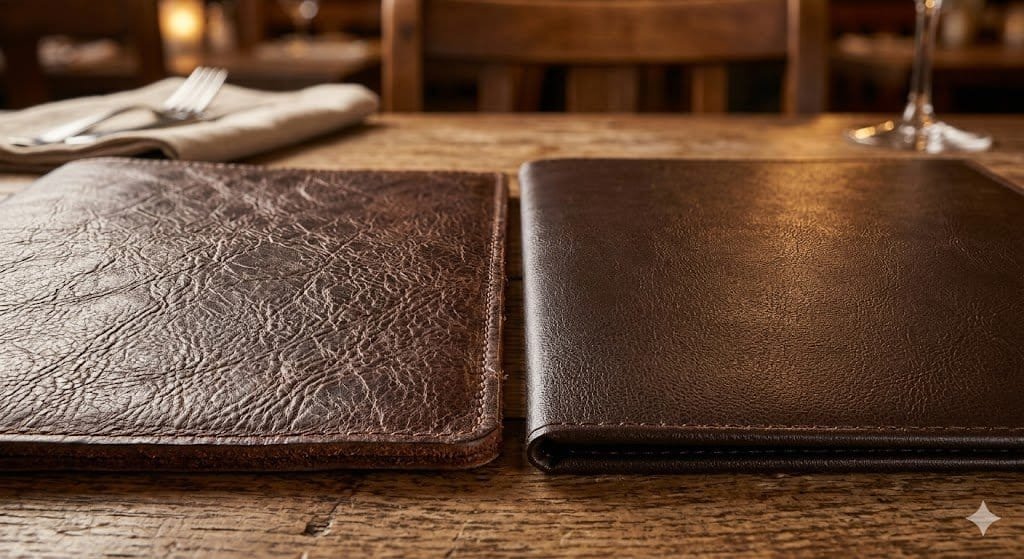
Most hospitality buyers are not leather experts. They know what good leather looks like in a finished product, but they cannot always tell from a photograph — or even from a sample — whether the material they are looking at is full-grain leather, top-grain leather, bonded leather or a well-made PU synthetic.
This matters because suppliers in the leather goods market do not always describe their materials accurately. “Genuine leather,” “real leather,” “PU leather” and “bonded leather” are used interchangeably by some suppliers in ways that misrepresent what the buyer is actually receiving.
This guide gives you the practical tests and knowledge to identify leather quality from a physical sample — so you can evaluate what you receive against what you were quoted.
The Leather Quality Hierarchy
Before testing, it helps to understand the four main categories of material marketed as leather, in descending order of quality:
Full-grain leather The outermost layer of the hide, with the natural surface intact. The grain pattern is visible and varies naturally across the hide — no two pieces are identical. Full-grain leather is the most durable, develops the richest patina and is the most expensive. Used in premium hospitality goods where longevity and quality are the primary criteria.
Top-grain leather Full-grain leather that has been lightly sanded and buffed to remove surface imperfections, then finished with a protective coating. More uniform in appearance than full-grain. Slightly less breathable and slightly less durable over the very long term, but still significantly better than anything below it in the hierarchy. The most common genuine leather specification for hospitality goods.
Bonded leather (reconstituted leather) Made from leather fibre scraps and dust — the waste from cutting genuine leather hides — bonded together with polyurethane binders and applied to a backing. Contains some percentage of genuine leather but behaves more like a synthetic than a genuine leather. Peels and delaminations in patterns similar to PU leather. Often sold as “genuine leather” because it technically contains leather content — a misleading claim.
PU leather (synthetic leather) No genuine leather content. A fabric or paper backing coated with polyurethane, textured to resemble leather. Varies enormously in quality — from cheap materials that peel within months to high-grade PU that maintains its appearance for several years. Not inherently dishonest as a material, but problematic when sold as genuine leather.
Physical Tests You Can Do on a Sample
Test 1: The edge test
Cut a small piece of material at the edge and look at the cross-section under good light.
- Genuine leather (full-grain or top-grain): the cross-section shows a fibrous, irregular interior — like the inside of a piece of paper that has been torn rather than cut. The fibre density and colour are uniform through the thickness.
- Bonded leather: the cross-section shows a thin genuine leather layer on the surface (sometimes visible as a slightly different colour) bonded to a backing material. The layers may be visible as distinct strata.
- PU leather: the cross-section shows a smooth, uniform synthetic coating on the surface and a woven or non-woven fabric backing. The coating and backing are clearly different materials.
This test is the most reliable single indicator of material type and requires only a sharp knife and good light.
Test 2: The water absorption test
Place a small drop of water on the surface.
- Genuine leather: absorbs the water slowly over ten to thirty seconds, darkening slightly at the absorption point. The darkening fades as the water evaporates.
- PU leather: the water beads on the surface and does not absorb. The surface remains unchanged.
- Bonded leather: variable — the surface coating may repel water, but if the coating is thin, absorption occurs faster than genuine leather.
Note: some genuine leathers are finished with a water-resistant coating that slows absorption. If the surface repels water but the edge test shows a fibrous cross-section, the material is likely coated genuine leather rather than PU.
Test 3: The smell test
Hold the sample close to your nose and breathe in.
- Genuine leather: a distinctive, natural, slightly organic smell. Difficult to describe precisely, but immediately recognisable to anyone familiar with leather goods. The smell fades gradually over the life of the product as natural oils evaporate.
- PU leather: a chemical, plastic-like smell. Stronger in new products; fades with time but does not develop the natural leather smell.
- Bonded leather: often smells more like genuine leather than PU because of the leather content, but can have a slight chemical undertone from the bonding agent.
Test 4: The stretch and flex test
Flex the sample firmly in your hands and observe the surface.
- Genuine leather: flexes naturally and recovers. The surface may show slight stress marks under extreme flexing — this is normal and does not indicate damage. The material returns to its original shape.
- PU leather: flexes but the surface coating may show fine creasing under repeated stress. High-grade PU flexes more naturally than low-grade.
- Bonded leather: often shows stress cracking on the surface under flexing. This is the early sign of the delamination that characterises bonded leather in use.
Test 5: The heat test (use with caution)
Apply brief, gentle heat from a hair dryer to a small area of the surface.
- Genuine leather: warms naturally and may become slightly more pliable. Returns to normal as it cools. Does not melt, bubble or produce a plastic smell.
- PU leather: may soften slightly and produce a faint chemical smell under sustained heat. Does not melt at low temperatures but reacts more noticeably than genuine leather.
- Bonded leather: similar to PU response.
Do not use an open flame for this test — all materials are flammable. A hair dryer on the highest setting for ten seconds is sufficient.
What to Look for in a Photograph
Physical testing requires a sample. For evaluating products from photographs alone, these visual indicators help:
Grain consistency: genuine leather grain varies naturally across a piece — the texture near the edge of a hide differs from the centre. PU and bonded leather have completely uniform texture across the entire surface. Very uniform grain in a photograph suggests synthetic material.
Surface imperfections: full-grain leather shows minor natural variations — small marks, slight colour variations, occasional pore irregularities. A perfectly flawless surface on a product described as full-grain leather is suspicious.
Edge finishing: genuine leather edges are typically finished with edge paint, burnishing or folded and stitched. Unfinished edges on a product described as genuine leather are unusual; the edge cross-section in a photograph can reveal the material structure.
Colour consistency: genuine leather in the same dye lot shows slight natural colour variation. Perfectly uniform colour across a large surface, particularly in rich colours, can indicate a heavily finished or synthetic material.
Applying This to Your Order
When you receive a sample from any supplier — including us — apply the edge test and the smell test before approving bulk production. These two tests together give a reliable indication of material type.
For our orders, we confirm the material specification in writing at the quotation stage and can provide material certificates on request. Our sampling process produces a sample in your specified material — genuine leather, high-grade PU or microfibre — and the sample is your reference point for the bulk production.
If a sample does not pass the tests above for the material you were quoted, do not approve bulk production. A discrepancy at the sample stage is recoverable; the same discrepancy across a 200-piece bulk order is not.
Material Options at HoReCa Leather
Understanding material quality helps you choose the right specification for your use case:
- Genuine leather (top-grain): for fine dining menu covers, hotel compendiums, corporate gifts for senior recipients
- High-grade PU: for casual dining chains, high-volume hotel amenities, volume gifting programmes
- Microfibre vegan leather: for vegan-specified hospitality goods
- Full-grain leather: available on request for premium specifications where maximum durability and patina development are required
For the full material comparison with cost and lifespan analysis, see our leather vs PU guide.
Ready to Request a Sample?
Use the quote form to request a sample in your specified material. We produce samples to your exact specification and you can apply the tests above when the sample arrives.
HoReCa Leather supplies custom leather hospitality goods from Shiling, Guangzhou. Material certificates available on request. MOQ from 50 pieces, 7-day sampling, DHL delivery to Europe and the Middle East.
Ready to source custom leather goods for your business?
MOQ 50 pieces. Sample in 7–10 days. Quote within 24 hours. Factory-direct from Shiling, Guangzhou.