Leather vs PU Menu Covers: Which Should Your Restaurant Choose?
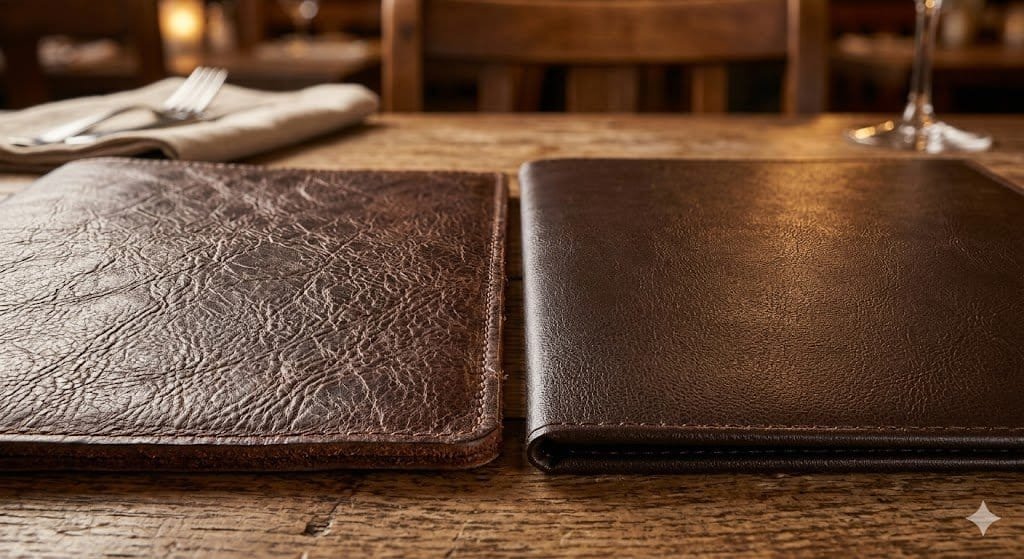
The most common question we receive from restaurant buyers is not about price or lead time. It is about material: should I order genuine leather or PU leather menu covers?
The honest answer is that neither is universally better. The right choice depends on your service environment, your replacement budget and what impression you want guests to take away from the table. This guide walks through the practical differences so you can make the decision confidently before placing your first order.
What the Two Materials Actually Are
Before comparing them, it helps to be precise about what each term means — because “PU leather” is used loosely in the market and covers a wide quality range.
Genuine leather (also called full-grain, top-grain or real leather) is made from actual animal hide — typically cowhide in the case of menu covers. Full-grain leather retains the natural surface of the hide and develops a patina with use. Top-grain leather has been lightly sanded to remove surface imperfections, giving a more uniform appearance while retaining most of the durability.
PU leather (polyurethane leather) is a synthetic material. A fabric or paper backing is coated with a polyurethane layer that is textured and coloured to resemble leather. Quality varies significantly: low-grade PU peels and cracks within months; high-grade PU — sometimes called “premium PU” or “bicast leather” — can look and feel convincing and last several years under regular use.
At HoReCa Leather, we supply both. The specification depends on what your operation actually needs, not what sounds most impressive on paper.
Side-by-Side Comparison
| Genuine Leather | PU Leather | |
|---|---|---|
| Lifespan | 5–10 years with normal use | 2–4 years (high-grade PU) |
| Appearance over time | Develops patina, ages well | Can peel or crack at edges |
| Wipe-clean surface | Yes, with appropriate conditioner | Yes, easier than genuine leather |
| Resistance to spills | Good, but requires prompt wiping | Very good, less absorbent |
| Weight | Heavier, more substantial feel | Lighter |
| Price per piece | Higher ($15–$25+ per cover) | Lower ($8–$15 per cover) |
| Logo embossing quality | Excellent, crisp impression | Good, slight variation by grade |
| Replacement frequency | Low | Medium |
| Best environment | Fine dining, low-turnover tables | Casual dining, high-turnover |
| Vegan/sustainability concerns | Uses animal hide | No animal products |
When Genuine Leather Is the Right Choice
Fine dining and upscale independent restaurants. When a guest picks up a menu cover, they form an impression of the restaurant before reading a single word. Genuine leather has a tactile quality — weight, grain, smell — that PU cannot fully replicate. For restaurants where the table setting is part of the experience, the material difference matters.
Low table turnover environments. Wine bars, private members clubs, tasting menu restaurants and hotel fine dining outlets typically have fewer covers in use at one time and turn tables less frequently. In these settings, a genuine leather cover that lasts eight years and develops character is far better value than a PU alternative replaced every two.
Venues with a heritage or craft narrative. If your restaurant’s identity is built around craft, provenance or premium ingredients, your tableware should be consistent with that story. PU leather at a premium price point creates a dissonance that guests sometimes notice, even if they cannot name it.
When you want a matched set across the room. Full-grain leather from the same hide batch produces a naturally consistent colour. Over time, covers age together and the variation becomes part of the aesthetic. PU covers, particularly lower-grade ones, can show uneven fading that makes a room look patchy after twelve to eighteen months.
When PU Leather Is the Right Choice
High-turnover casual dining. If your restaurant turns tables three or four times a night, your menu covers are handled dozens of times daily. Spills, sticky hands and rough treatment are facts of service. In this environment, a $10 PU cover that you replace in three years is more economical than a $22 genuine leather cover that gets damaged within one.
Large chain rollouts with consistent replacement cycles. Groups managing twenty or more locations often prefer PU because it allows them to replace all covers across all sites on a scheduled cycle, maintaining brand consistency. The lower unit cost makes budgeted replacement straightforward.
Outdoor terraces and poolside dining. UV exposure, humidity and temperature variation accelerate the deterioration of genuine leather outdoors. High-grade PU, particularly if treated for UV resistance, holds its appearance better in exposed environments. For any outdoor setting, PU is almost always the more practical specification.
Budget refreshes and seasonal menus. If you update your menu design frequently — seasonal menus, rotating specials, regular branding refreshes — you may not want a cover that outlasts the menu insert by five years. PU leather at a lower per-piece cost makes it easier to refresh the table aesthetic without significant capital spend.
What About Vegan Leather?
Some buyers ask specifically about vegan options — usually because their brand identity excludes animal products, or because they are sourcing for a plant-based restaurant concept.
PU leather is already animal-free by definition. We also supply microfibre vegan leather, which offers a closer hand-feel to genuine leather and better durability than standard PU. It sits between the two in both price and lifespan.
For buyers with sustainability concerns, the picture is more nuanced than the vegan/non-vegan distinction suggests. Genuine leather is a by-product of the meat industry (the hide would otherwise be waste), while PU leather uses petrochemical inputs and is not biodegradable. Neither has a clear environmental advantage in all scenarios. If sustainability is a key purchasing criterion, we can discuss material sourcing and certifications in more detail when you request a quote.
The Embossing Question
One practical difference that buyers sometimes overlook is how each material takes a logo.
Genuine leather accepts a hot stamp or blind emboss very cleanly. The impression is sharp and permanent — it will not rub off or fade in the way a printed logo can. Gold and silver foil stamping on genuine leather produces a result that genuinely looks premium.
PU leather also accepts embossing and foil stamping, but the result depends on the specific PU grade. High-grade PU gives a result that most guests would not distinguish from genuine leather. Lower-grade PU can show soft or slightly blurred edges on detailed logos.
If your logo includes fine lines or small text, genuine leather is the safer specification. If your logo is bold and simple — a wordmark or monogram — high-grade PU will produce a result you will be satisfied with.
We send a digital proof and, if you request it, a physical logo sample on your chosen material before any bulk production begins. This eliminates the risk of receiving a large order with an embossing result you did not expect.
Price Difference in Practice
At current factory-direct pricing from Shiling:
- PU leather menu covers: $8–$15 per piece at MOQ 50 pcs
- Genuine leather menu covers: $15–$25 per piece at MOQ 50 pcs
For a 50-table restaurant ordering 60 covers (table count × 1.2):
| PU Leather | Genuine Leather | |
|---|---|---|
| Unit price | $10 | $20 |
| Initial order (60 pcs) | $600 | $1,200 |
| Replacement at year 3 | $600 | — |
| Replacement at year 5 | $600 | — |
| Replacement at year 6 | — | $1,200 |
| 10-year total cost | $2,400 | $2,400 |
Over a ten-year period, the total cost of ownership is often similar — genuine leather costs more upfront but less frequently. The genuine leather option also holds its appearance better in years four through eight, which matters for venues where presentation is a competitive factor.
This calculation changes if your PU covers are damaged earlier than expected, or if you upgrade genuine leather covers before they wear out. The honest starting point is to assess your service environment honestly and choose the material that fits your actual conditions — not the one that sounds most prestigious in a product description.
Making the Decision
Ask yourself three questions:
1. How many times is each cover handled per day? Under 10 times: genuine leather. Over 20 times: PU leather or high-grade microfibre.
2. What does the rest of your table setting communicate? Linen napkins, heavy glassware, high plate prices: genuine leather. Relaxed environment, everyday pricing: PU leather is fine.
3. Are you replacing on a schedule or when covers wear out? Scheduled replacement: PU leather. Replace-when-worn: genuine leather.
If you are still uncertain, the most practical solution is to order a physical sample of both materials before committing. We ship samples from Shiling via DHL — most European buyers receive them within five to seven working days.
Ready to Choose?
Browse our leather menu covers to see the full range of materials, sizes and colours available. Use the quote form to tell us your product, quantity and logo, and we will confirm pricing for both genuine leather and PU options so you can compare directly.
For restaurants sourcing menu covers alongside check presenters or wine list covers, we can match material and colour across all three products in a single order.
HoReCa Leather supplies custom restaurant leather goods from Shiling, Guangzhou. MOQ from 50 pieces, 7-day sampling, DHL delivery to Europe and the Middle East.
Ready to source custom menu covers for your restaurant?
MOQ 50 pieces. Sample in 7–10 days. Quote within 24 hours. Factory-direct from Shiling, Guangzhou.