Leather Menu Covers for Casual Dining Chains: A Multi-Site Procurement Guide
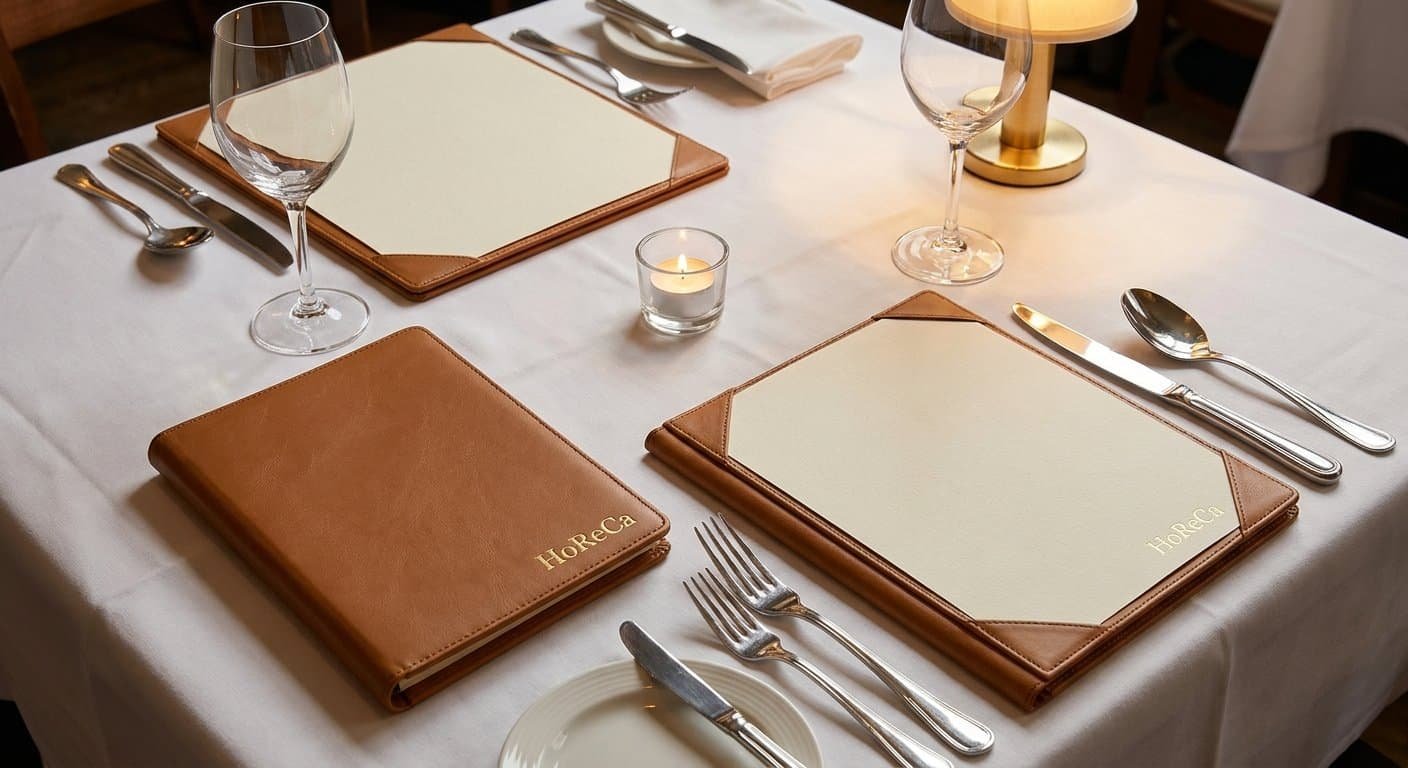
Casual dining chains have a procurement challenge that independent restaurants do not: consistency across sites. A menu cover that works perfectly at one location needs to look identical at twenty others — same colour, same logo impression, same weight — even when covers from different batches are sitting side by side on the same table during a site visit.
This guide covers the specific requirements for multi-site casual dining procurement: how to specify for consistency, how to consolidate orders across sites, and how to manage replacement cycles across a network of properties.
The Multi-Site Consistency Problem
Leather goods ordered from different production batches — even to the same specification — can show colour variation. Dye lots in leather are not as precisely controlled as paint or ink. A black cover ordered in March and the same specification ordered in September may look almost identical, or may show a visible difference when placed side by side.
For a single restaurant, this is not a significant problem. For a chain where a regional manager visits multiple sites and places covers from different orders on the same table, it becomes a brand consistency issue.
The solution is consolidated ordering: sourcing all sites’ covers in a single production run, from the same leather batch, at the same time. This guarantees consistency across the network and typically produces better per-unit pricing than individual site orders.
Consolidated Ordering: How It Works
Step 1: Collect site requirements
Gather the table count and document requirements for every site. A standardised brief template helps:
| Site | Tables | Food menu covers | Drinks covers | Check presenters | Buffer stock |
|---|---|---|---|---|---|
| Site A | 45 | 54 | 54 | 25 | +10% |
| Site B | 60 | 72 | 72 | 33 | +10% |
| Site C | 38 | 46 | 46 | 21 | +10% |
| Total | 143 | 172 | 172 | 79 |
Step 2: Add central buffer stock
In addition to site quantities, order a central buffer of 5–10% of total quantity to hold at head office or a central warehouse. This stock covers urgent replacements at any site without requiring a new order.
Step 3: Single production run
Submit the total quantity as a single order. All covers produced from the same leather batch, same embossing die, same stitching thread. Delivered to a central address for distribution to sites, or split-shipped to individual site addresses.
Step 4: Scheduled replacement cycle
Plan the next consolidated order before the current stock runs low. For casual dining at typical volume, plan for replacement every 18 to 24 months.
Material Specification for Casual Dining
Genuine leather is rarely the right specification for casual dining chains. The combination of high table turnover, multiple sittings per service, and the inevitable rough handling of a busy casual environment accelerates wear beyond what justifies the genuine leather premium.
High-grade PU leather in a dark colour — black, dark brown, navy — is the standard specification for most casual dining chains. The reasons:
Consistent appearance across a large batch. PU leather dye lots are more controlled than genuine leather, which means a large batch of PU covers is more likely to be colour-consistent than an equivalent genuine leather order. For a chain ordering 500 covers at once, this matters.
Wipe-clean practicality. Casual dining covers encounter ketchup, mayonnaise, sticky drinks and food debris as routine. PU leather handles this without the care that genuine leather requires.
Scheduled replacement economics. A casual dining chain that replaces covers on a fixed 24-month cycle needs a per-unit price that makes the replacement cost manageable. High-grade PU at $10–$14 per cover is appropriate; genuine leather at $20–$25 is harder to justify when the covers will be replaced regardless of condition.
For a full material comparison, see our leather vs PU guide.
Brand Standard Compliance
Most casual dining chains have documented brand standards that specify menu cover requirements. Common parameters:
Colour: usually specified by Pantone reference or RAL code, sometimes by a proprietary brand colour name. We match to Pantone references for PU leather; for non-standard colours, a physical swatch approval before bulk production is recommended.
Logo: brand standards typically specify logo file, size and placement. Provide the brand standard document and we will confirm compliance in the digital proof before production. All covers in a consolidated order use a single embossing die, ensuring logo consistency across every piece.
Format: brand standards may specify cover dimensions, pocket configuration and closure type. Non-standard formats are produced to order without additional tooling cost on orders of 100 pieces or more.
Material grade: some brand standards specify a minimum material grade (“premium PU” or “bonded leather minimum”). We confirm material specification in writing and can provide material certificates if required by the brand’s supplier qualification process.
Replacement Cycle Management
The most common procurement failure in casual dining chains is reactive replacement: covers are replaced when they become visibly unacceptable, which typically means guests have already been experiencing deteriorated covers for several months before the order is placed.
A proactive replacement cycle — ordering before covers reach the end of their service life — maintains brand standards and eliminates the lead time pressure of urgent replacement orders.
Recommended cycle for casual dining:
| Volume | Material | Recommended cycle |
|---|---|---|
| Under 100 covers per night | High-grade PU | 24–30 months |
| 100–200 covers per night | High-grade PU | 18–24 months |
| Over 200 covers per night | High-grade PU | 12–18 months |
Set a calendar reminder for the reorder six weeks before the planned replacement date. This allows time for production and delivery without rushing.
We hold your specification on file after the first order. Repeat orders can be placed without repeating the full brief and sampling process, provided the specification has not changed. Repeat order lead time is typically shorter than first-order lead time.
Split Shipping for Multi-Site Delivery
For chains with sites across multiple countries or regions, we offer split shipping: a single production run delivered to multiple addresses via DHL. Each site receives its allocation directly, reducing handling and distribution cost at the chain’s end.
Split shipping works best when site addresses and quantities are confirmed before production begins. Provide a delivery manifest — site name, address, quantity per product — and we build it into the shipping plan before the order leaves Shiling.
For large consolidated orders, sea freight to a central European warehouse (typically 25–35 days transit) followed by domestic distribution is often more cost-effective than DHL for every site. We can quote both options and advise on the threshold where sea freight makes economic sense.
Quantity Planning Across Sites
Use the standard formula for each site — table count × 1.2 for food menu covers — then aggregate across the network. Add a central buffer of 5–10% of total quantity.
For a detailed explanation of the quantity calculation and annual loss rate by venue type, see our menu cover quantity guide.
Our minimum order quantity is 50 pieces per product line. For multi-site orders, the combined quantity across sites almost always exceeds this threshold comfortably — and higher quantities attract better per-unit pricing.
Ready to Start a Consolidated Order?
Send us your site list with table counts and document requirements, your brand standard document or colour reference, your logo file, and your required delivery date or replacement cycle date.
Use the quote form or contact us directly for multi-site enquiries. We reply within 24 hours with consolidated pricing, a production schedule and a digital proof for approval.
Browse our leather menu covers and check presenters for format and colour reference.
HoReCa Leather supplies custom leather menu covers for restaurant chains from Shiling, Guangzhou. Consolidated multi-site ordering, split shipping available, MOQ 50 pieces per product line.
Ready to source custom menu covers for your restaurant?
MOQ 50 pieces. Sample in 7–10 days. Quote within 24 hours. Factory-direct from Shiling, Guangzhou.