Leather Menu Covers for Fine Dining Restaurants: A Specification Guide
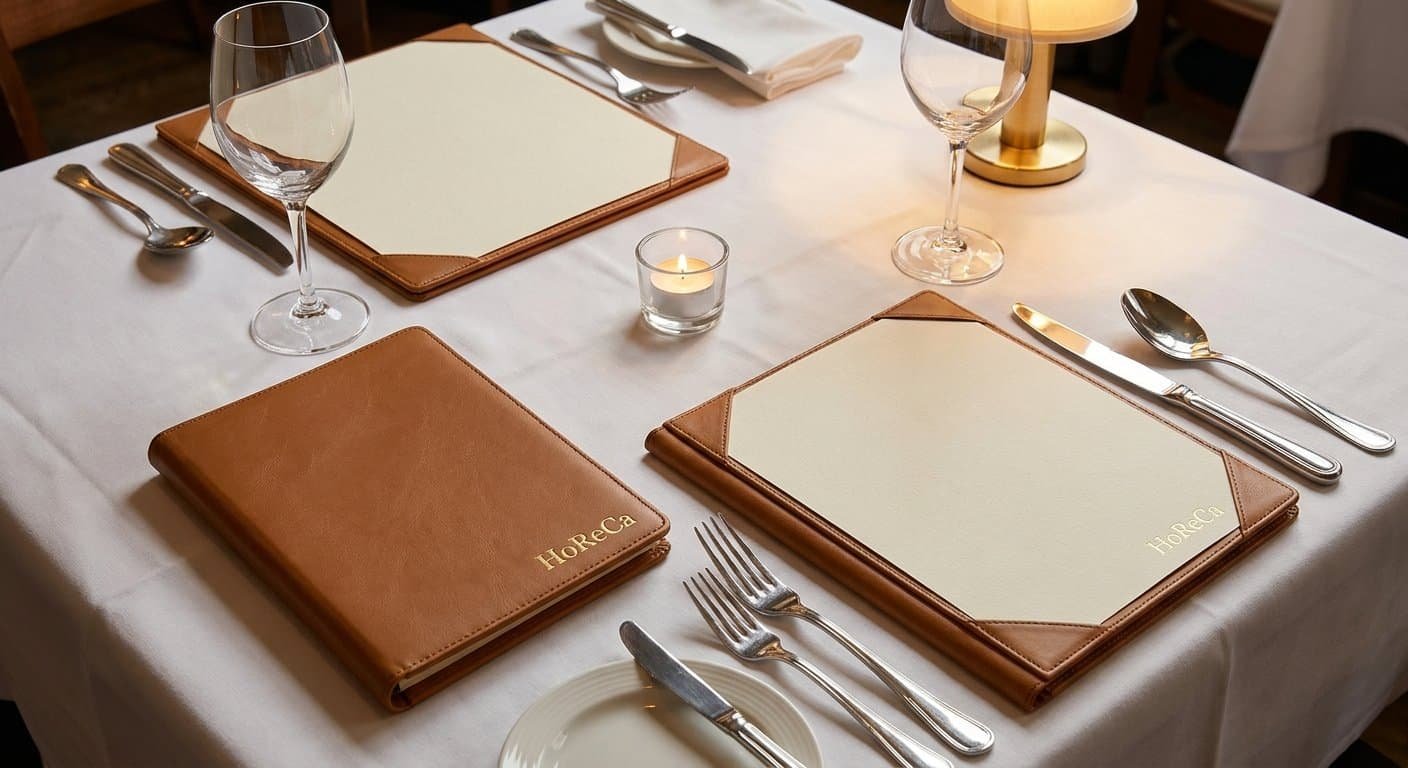
In fine dining, the menu cover is not a container for a piece of paper. It is the first physical object a guest touches after sitting down — the opening gesture of an experience that will be judged on the quality of every detail.
This creates a different specification challenge from other restaurant contexts. The question is not which cover is most durable or most cost-effective per unit. The question is which cover will hold its quality and appearance for the duration of its service life, communicate the correct level of craft and investment, and sit correctly in the context of the table setting.
This guide covers the specific requirements for fine dining menu covers: material, format, size, logo treatment and coordinating products.
Material: Why Genuine Leather Is the Only Serious Option
For fine dining, PU leather is not an appropriate specification. The reasons are tactile as much as visual.
A guest who has paid £120 for dinner picks up a menu cover before seeing a single dish. If the cover feels lightweight, if the surface has the uniform texture of synthetic material, if it lacks the slight resistance of real leather — the signal is registered, even if it is not consciously articulated. Fine dining guests are attuned to material quality. They spend time in environments where materials are chosen carefully. They notice.
Genuine full-grain or top-grain leather has a weight and hand-feel that cannot be replicated in PU. It warms slightly in the hands. It has a grain that is subtly irregular — the natural variation of animal hide — rather than the machine-pressed uniformity of synthetic material. Over time it develops a patina that becomes part of the restaurant’s character.
The practical case is also sound. As covered in our leather durability guide, genuine leather in a fine dining environment — where covers are handled carefully, stored correctly and used at low volume — can last seven to ten years. The higher unit cost distributes over a long service life, producing a total cost of ownership comparable to or lower than PU covers replaced every two to three years.
Leather Grade and Finish Options
Within genuine leather, there are choices that affect appearance, price and ageing behaviour:
Full-grain leather The top layer of the hide, with the natural grain intact. The most expensive grade and the most durable. Develops the richest patina. Minor surface marks become part of the leather’s character rather than damage. The correct specification for covers that are expected to last a decade.
Top-grain leather Full-grain leather that has been lightly sanded to remove surface imperfections, then finished with a protective coating. More uniform in appearance than full-grain, slightly less durable over the very long term, but still significantly better than any synthetic alternative. The most common specification for fine dining at a price point that does not require full-grain.
Vegetable-tanned (veg-tan) leather Tanned using plant-based tannins rather than chromium salts. Develops a more pronounced patina and has a distinctive smell that guests often associate with quality craftsmanship. More expensive and requires more careful maintenance. Specified by restaurants with a strong artisanal identity — farm-to-table concepts, chef-patron restaurants with a craft narrative.
Finish: – Natural grain — the leather’s own surface texture, preserved and lightly treated. The most authentic appearance. – Pebbled grain — a pressed texture that conceals minor scratches and handling marks. Practical without sacrificing the feel of genuine leather. – Smooth — a refined, flat finish. Elegant in photographs; shows handling marks more readily.
Format: Coordinated Sets Over Individual Pieces
Fine dining service involves multiple documents presented to the guest at different moments: the menu at arrival, the wine list when the sommelier approaches, the dessert menu after the main course, the check presenter at the end. Each should be in the same leather, the same colour, the same logo treatment.
A coordinated set for a fine dining restaurant typically includes:
Main menu cover — A4 or a custom portrait format, depending on the menu design. Single fold with a spine if the menu is a multi-page booklet. The primary document and the most visible element of the set.
Wine list cover — often in a taller, narrower format than the food menu, allowing the wine list to be presented as a distinct document rather than an afterthought. Some fine dining restaurants use a substantial leather binder for an extensive wine list; others prefer a slim cover for a short, curated selection.
Dessert menu cover — typically A5 or a custom format, smaller than the main menu to signal the shift in the meal’s arc. Presented by the server rather than left on the table.
Check presenter — double-fold format for fine dining, with separate pockets for the bill, the payment card and the receipt. A pen loop on the spine. Presented by the server, not left on the table.
Producing all four in a single run from the same leather batch ensures colour consistency across the set — essential in fine dining where any inconsistency across the table reads as a lack of attention to detail.
Logo Treatment for Fine Dining
Fine dining restaurants tend toward restraint in logo treatment. The most common specification is a blind emboss — the logo pressed into the leather without foil, visible as a subtle relief. It communicates presence without announcing itself.
Gold foil is used when the restaurant’s visual identity includes gold as a primary brand colour, or when the leather is dark and a foil impression is needed for legibility. Silver foil is less common in fine dining but suits restaurants with a contemporary, minimalist identity.
What to avoid: screen-printed logos, large logo placements that dominate the cover surface, or multiple logo placements on a single cover. Fine dining restraint extends to branding.
Positioning: the most common placement is bottom right on the front cover — visible when the cover is on the table but not the first thing the eye goes to. Some restaurants specify an interior placement only — the logo appears when the cover is opened, rather than on the front. This is the most understated option and suits restaurants where the room is the statement, not the brand.
For logo file requirements and embossing method detail, see our logo guide.
Colour and Interior Specification
Colour: Fine dining restaurants typically specify colours in the darker or neutral range — black, dark brown, cognac, forest green, slate. Lighter colours (tan, camel, cream) are occasionally specified to coordinate with a specific interior palette but require more careful maintenance and show soiling faster.
Custom colours matched to a Pantone reference or interior swatch are available on orders of 100 pieces or more. For restaurants where the leather colour is a considered design decision, a physical swatch approval before production is strongly recommended — leather colour under restaurant lighting often differs from how it appears in photographs.
Interior: The inside of a fine dining cover can include: – A silk or microfibre lining — adds a refined tactile quality when the cover is opened – A ribbon page marker — for multi-page menus where the guest needs to find their place – A card pocket — for business cards, reservation cards or a personal message from the chef – A branded interior message — embossed or printed on the inside front cover
Specify interior details in the brief and we will include them in the digital proof for approval.
Sizing for Fine Dining Menus
Fine dining menus tend to use custom sizes more than casual restaurants — the menu design is part of the overall aesthetic, and standard paper sizes are not always the right format.
Common fine dining menu formats: – Square — a square menu (typically 200 × 200 mm or 220 × 220 mm) makes a visual statement and is popular with modernist restaurant concepts – Tall portrait — a narrow, tall format (around 130 × 300 mm) suits a concise tasting menu presented as a single card – Standard A4 — used when the menu is designed for standard paper but presented in a premium cover – Oversized — some fine dining restaurants use a deliberately oversized cover (260 × 360 mm or larger) as a design gesture
For any custom format, provide the insert dimensions and we will cut the cover to fit. See our sizes guide for full dimension reference and ordering instructions.
Quantity and Replacement Planning
Fine dining restaurants have low table counts and low cover-per-night volumes compared to casual restaurants. The quantity calculation is the same — table count × 1.2 — but the numbers are usually small.
A 20-table fine dining restaurant needs approximately 24 main menu covers. At a loss and damage rate of 5–8% per year in a careful fine dining environment, that is one to two covers replaced annually. The replacement stock built into the initial order (the 20% buffer) typically lasts three to four years before a reorder is needed.
At this scale, the 50-piece MOQ produces a significant surplus over immediate needs — which is the correct approach. The surplus is your replacement stock for the first several years of service.
For the full quantity planning logic, see our menu cover quantity guide.
The Sample Stage
For fine dining specifications — where the leather quality, colour and logo treatment are a considered design decision — a physical sample before bulk production is not optional. It is the stage at which you confirm that what we produce matches what you specified.
Send us your brief, including your logo file, colour reference and format dimensions. We produce a digital proof within 24 hours and a physical sample within seven working days. The sample ships DHL from Shiling and arrives in most of Europe within five to seven working days.
Review the sample under your restaurant’s lighting conditions — not in an office or in daylight. Leather colour and logo impression look different under warm restaurant lighting than in photographs or under fluorescent office light.
Ready to Specify?
Use the quote form to send us your menu format, insert dimensions, quantity, leather grade preference, colour reference and logo file. We reply with full pricing, a production schedule and a digital proof within 24 hours.
Browse our leather menu covers and wine list covers for format and colour reference, or contact us to discuss a bespoke specification.
HoReCa Leather supplies custom leather menu covers for fine dining restaurants from Shiling, Guangzhou. MOQ from 50 pieces, genuine leather available in all grades, 7-day sampling, DHL delivery to Europe and the Middle East.
Ready to source custom menu covers for your restaurant?
MOQ 50 pieces. Sample in 7–10 days. Quote within 24 hours. Factory-direct from Shiling, Guangzhou.