How Many Menu Covers Does a Restaurant Need?
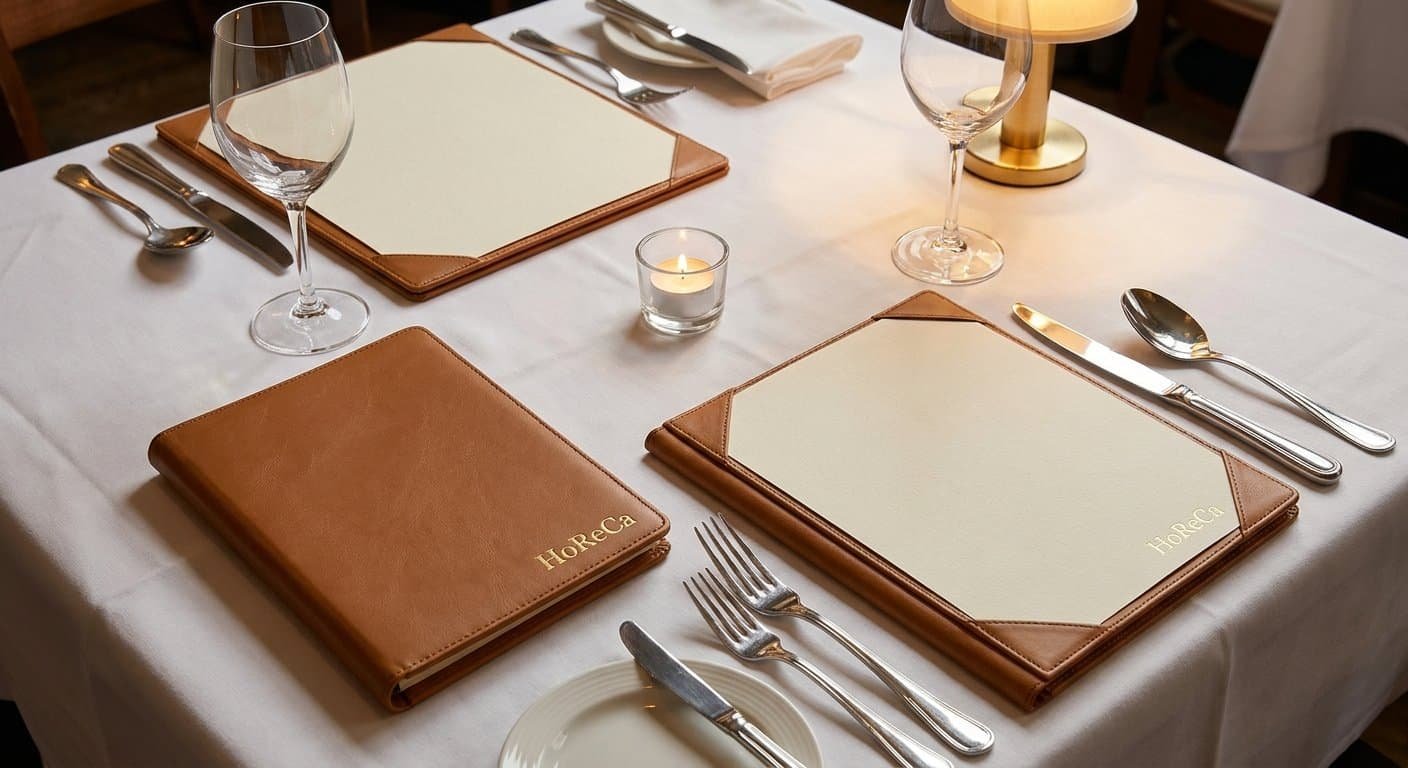
Most restaurants order too few menu covers on their first order. A handful get damaged in the first month, a few more go missing, and suddenly a 50-table restaurant is seating guests with mismatched covers while waiting on a reorder.
This guide gives you the actual numbers — how to calculate your starting quantity, how to account for damage and loss, and how to plan reorders before you run short.
The Baseline Formula
The starting point is simple:
Order quantity = table count × 1.2
The 1.2 multiplier builds in a 20% buffer for damage, loss and expansion. For most restaurant formats, this buffer is the minimum you should hold.
| Tables | Minimum order | Recommended order |
|---|---|---|
| 20 | 24 | 30 |
| 30 | 36 | 40 |
| 40 | 48 | 55 |
| 50 | 60 | 65 |
| 75 | 90 | 100 |
| 100 | 120 | 130 |
| 150 | 180 | 200 |
The “recommended order” column rounds up to a practical quantity and adds a slightly larger buffer for venues that expect growth in their first year.
Adjusting for Your Service Format
The baseline formula works for a standard à la carte restaurant where one menu cover sits on each table. Several common service formats require a different calculation.
Multi-page menu systems
If your menu is split across separate covers — a food menu, a wine list and a cocktail menu, for example — multiply the table count by the number of covers per table, then apply the 1.2 buffer.
A 40-table restaurant with a food menu and a separate wine list cover on each table needs:
40 tables × 2 covers × 1.2 = 96 covers total (48 of each type)
Set menus and tasting restaurants
Restaurants where each guest receives their own menu — rather than one per table — need to calculate by seat count, not table count.
A 30-table restaurant with an average of 3 guests per table needs:
30 tables × 3 seats × 1.2 = 108 individual menu covers
In practice, tasting menu restaurants often use single-use printed inserts inside a reusable leather cover, which reduces the per-seat cost significantly. One cover per table is sufficient if inserts are replaced per service.
Restaurants with private dining rooms
Count private dining room tables separately and add them to your main dining room total before applying the buffer. A private dining room that seats 20 across 5 tables needs its own cover set — typically in a coordinating but distinct design to differentiate the experience.
Counter dining and bar seating
Bar menus and counter menus are handled more roughly than table menus. Increase the buffer to 1.4× for bar and counter positions.
A 20-seat bar area needs: 20 × 1.4 = 28 bar menu covers
Planning for Damage and Loss
Understanding how covers actually get damaged helps you plan your buffer more accurately.
The most common causes of damage:
- Liquid damage — Wine, sauce and water spills are inevitable. Genuine leather handles occasional spills well if wiped promptly; PU leather is more resistant but can delaminate at seams after repeated soaking. See our leather vs PU guide for a full comparison.
- Corner and spine wear — The corners and spine take the most stress from repeated opening and stacking. Lower-quality covers show wear here first; look for reinforced corners when specifying.
- Staff handling — Covers stacked carelessly, dragged across surfaces or stored damp deteriorate faster than those handled correctly. A brief staff briefing on storage and handling extends cover life significantly.
- Guest handling — Some guests fold, bend or sit on menu covers. This is unavoidable. It is part of why the buffer exists.
- Logo wear — Foil-stamped logos on high-traffic covers can show wear after two to three years. Blind embossing (no foil) holds up better on covers that are handled constantly.
Annual loss rate by venue type:
| Venue type | Estimated annual loss/damage rate |
|---|---|
| Fine dining (low turnover) | 5–8% of stock per year |
| Casual dining (medium turnover) | 12–18% of stock per year |
| High-volume casual / pub dining | 20–30% of stock per year |
| Bar and counter menus | 25–35% of stock per year |
A 50-table casual dining restaurant with 65 covers in stock should expect to replace 8–12 covers per year. At $10–$15 per PU cover, that is a straightforward annual maintenance cost.
When to Reorder
The right time to reorder is before you run short, not after. The practical trigger point is when your usable stock drops to your table count — i.e., when you have used up your buffer.
For a 50-table restaurant that started with 65 covers: reorder when usable stock drops to 50.
Lead time to plan for:
- Physical sample (if specifying a new design or first order): 7 days from Shiling to most of Europe
- Production lead time: 15–25 working days after sample approval
- DHL delivery: 5–7 working days
Total time from order to delivery: approximately 4–5 weeks for a repeat order without a new sample.
If you are ordering for a restaurant opening, place your cover order at least six weeks before your opening date. This allows time for a sample review and production without pressure.
Ordering for a Chain or Group
Multi-site groups have a different calculation challenge: maintaining consistency across locations while allowing for different table counts at each site.
The most practical approach for groups:
- Calculate each site’s individual quantity using the table count × 1.2 formula
- Add all site quantities together for a combined order
- Apply a group-level buffer of an additional 5–10% to hold centrally as a repair stock
This approach gives you economies of scale on production pricing while keeping a central stock to supply any location that runs short between full reorders.
Groups ordering 500 pieces or more across locations can negotiate unit pricing well below the MOQ rate. Contact us with your site list and we will provide consolidated pricing.
Coordinating Covers with Other Table Items
If you are ordering check presenters or wine list covers alongside your menu covers, apply the same quantity logic to each product — but the ratios differ.
Check presenters are used at the end of service, so you need fewer than menu covers. One per two tables is usually sufficient for standard service flow. For high-turnover restaurants where bills are presented frequently, one per table is safer.
Wine list covers — if separate from the food menu — sit on the table throughout service but are typically handled less than the main menu. Table count × 1.1 is usually adequate.
Clipboards for server order-taking are calculated by server count, not table count. One per server plus two spares is the standard specification.
Ordering all items together in a single production run ensures colour and leather batch consistency. Covers from different production runs can show slight colour variation even when ordered to the same specification. For a matched table setting, a single order is always preferable to separate orders placed weeks apart.
A Quick Reference: Order Quantities by Restaurant Size
| Restaurant size | Tables | Food menu covers | Wine list covers | Check presenters |
|---|---|---|---|---|
| Small independent | 20–30 | 30–40 | 25–35 | 15–20 |
| Medium independent | 40–60 | 55–75 | 45–65 | 25–35 |
| Large independent | 70–100 | 90–125 | 80–110 | 40–55 |
| Small chain site | 50–80 | 65–100 | 55–90 | 30–45 |
| Hotel F&B outlet | 40–70 | 55–90 | 50–80 | 25–40 |
These are starting point estimates. Your actual count should be based on your specific table layout, service format and anticipated turnover.
Summary
The reliable starting quantity for menu covers is your table count multiplied by 1.2. Adjust upward for high-turnover formats, per-guest service, bar seating or multi-cover table settings. Plan your reorder when usable stock drops to your table count, and allow four to five weeks for production and delivery.
If you are placing a first order and want to verify the material and logo before committing to full quantity, request a sample first. Samples ship from Shiling via DHL and arrive in most of Europe within five to seven working days.
Browse our leather menu covers to see the full specification options, or use the quote form to send us your table count, material preference and logo for a direct price.
HoReCa Leather supplies custom restaurant leather goods from Shiling, Guangzhou. MOQ from 50 pieces, 7-day sampling, DHL delivery to Europe and the Middle East.
Ready to source custom menu covers for your restaurant?
MOQ 50 pieces. Sample in 7–10 days. Quote within 24 hours. Factory-direct from Shiling, Guangzhou.