How to Store Leather Menu Covers: A Restaurant Guide to Extending Cover Life
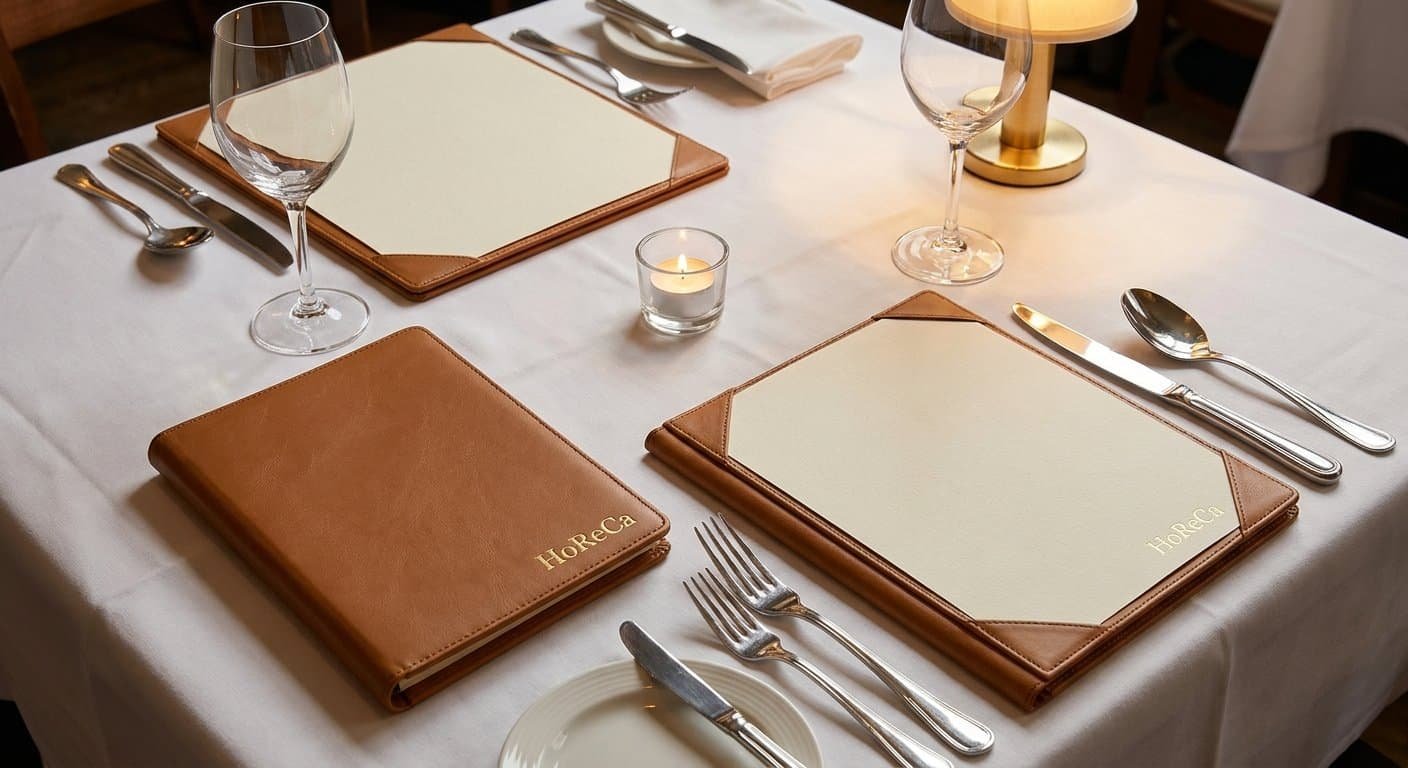
Most restaurants clean their menu covers correctly and store them incorrectly. The cleaning gets attention because it is visible — a guest sees a dirty cover and someone notices. Storage happens out of sight, after service, when everyone wants to go home. The result is that covers cleaned carefully every evening are stacked damp in a warm corner and develop mould, warping or delamination that cleaning cannot reverse.
Correct storage costs nothing and adds less than two minutes to the end-of-service routine. This guide covers the specific storage requirements for both genuine leather and PU leather covers, and the most common storage mistakes that shorten cover life.
The Single Most Important Rule
Never stack leather menu covers while they are damp.
Damp covers stacked together trap moisture between them. In genuine leather, trapped moisture promotes mould within 24 to 48 hours and begins breaking down the leather fibres over weeks. In PU leather, trapped moisture penetrates between the polyurethane coating and the backing material, accelerating the delamination that eventually causes PU covers to peel at the edges and corners.
Most covers at the end of service are damp — from wiping down after use, from condensation in a warm dining room, or from minor spills absorbed during service. The practical solution is a brief drying period before stacking: lay covers open on a flat surface for fifteen to twenty minutes at the end of service, then stack once the surfaces are dry to the touch.
In a restaurant with a designated cover storage area away from the kitchen, this is straightforward. In a tight operation where covers go directly from the floor to a storeroom shelf, it requires a small change to the end-of-service routine.
Storage Position: Flat or Upright
Leather menu covers should be stored either flat or upright. Both methods preserve the cover’s shape and prevent the spine distortion that causes covers to no longer close properly.
Flat stacking is the most common method. Stack covers horizontally with the spine aligned, on a clean dry surface. Limit genuine leather stacks to fifteen covers maximum — excessive weight on the bottom covers in a tall stack causes spine compression over time. PU leather stacks can be slightly taller.
Upright storage in a purpose-built rack or on a bookshelf is the preferred method for covers that are stored for longer periods — off-season covers, surplus stock, or covers taken out of rotation for cleaning. Upright storage prevents compression and allows air circulation between covers.
Never store covers: – Folded back on themselves past 180 degrees – Under heavy objects – Wedged into a space too small for the cover, which forces the spine into an unnatural angle – Balanced on their spine edge, which causes the cover to bow over time
Temperature and Humidity
Leather is sensitive to both temperature extremes and humidity. The ideal storage environment is cool, dry and well-ventilated — conditions that most restaurant back-of-house areas do not naturally provide.
Heat: storage near dishwashers, ovens, heat lamps or boilers accelerates moisture evaporation from genuine leather, causing the fibres to dry out and crack. A genuine leather cover stored near a dishwasher exhaust for six months will show cracking at the spine and corners that conditioning cannot fully reverse.
Cold and damp: cold combined with humidity promotes mould. Basement storage areas, external storage rooms and areas near refrigeration units can produce conditions where mould develops on leather covers within days, particularly if covers are stored slightly damp.
Ideal conditions: room temperature (15–22°C), relative humidity 45–60%, away from direct heat sources and away from areas of temperature fluctuation.
In practice, a clean dry shelf in a staff area or dry goods storage room is usually adequate. The key requirement is that the area is dry — temperature is less critical than humidity.
Protecting the Logo
The embossed logo on a leather menu cover is more durable than a printed or foil-applied logo, but it can still be affected by incorrect storage.
Blind emboss: the most durable logo treatment — a relief impression in the leather that is unaffected by storage conditions if the leather is kept in good condition. No additional protection needed.
Foil stamp: gold or silver foil embossing can be scratched by covers rubbing against each other in storage. If foil covers are stacked, place a sheet of clean tissue paper or a microfibre cloth between covers to prevent the foil surfaces from contacting each other directly.
Printed logo: the least durable logo treatment and the most affected by storage. Store printed covers in the same way as foil covers, with tissue paper between layers.
Seasonal and Off-Rotation Storage
Restaurants that use different menus seasonally — a summer terrace menu, a Christmas menu, a prix-fixe event menu — often have covers that are taken out of rotation for months at a time. These covers need preparation before storage.
Before extended storage: – Clean thoroughly with the appropriate cleaner for the material – For genuine leather: apply a coat of leather conditioner and allow it to absorb fully before storing – Allow covers to air dry completely — at least two hours — before closing them and stacking – Store upright where possible, or flat with tissue paper between covers
Before returning to service: – Inspect for mould, cracking or any damage that developed during storage – Wipe with a damp cloth to remove any dust – For genuine leather: apply a light conditioning treatment if the covers have been in storage for more than three months
A Simple End-of-Service Storage Routine
The following routine adds approximately two minutes to the end of service and prevents the majority of storage-related cover damage:
- Wipe down all covers with a barely damp cloth after the last service
- Lay covers open on a flat surface — spine down, covers open — for fifteen minutes
- Check each cover for damage or staining that needs attention before the next service
- Stack flat on a dry shelf, aligned at the spine, maximum fifteen per stack for genuine leather
- Ensure the storage area is not near a heat source or in a damp location
For covers that were exposed to spills during service, extend the drying time to thirty minutes before stacking.
Storage Equipment Worth Considering
For restaurants with a larger cover collection — multiple document types, surplus stock, seasonal covers — a small investment in storage equipment pays back in extended cover life.
Cover rack: a vertical rack that holds covers upright, spaced apart, allows air circulation and prevents compression. Available from restaurant supply companies or can be improvised from a wine rack or bookend system.
Labelled shelving: if multiple cover types are stored together — food menu covers, wine list covers, check presenters — labelled shelf positions prevent staff from mixing covers and stacking incompatible sizes together, which causes warping.
Silica gel packets: in storage areas with variable humidity, silica gel packets placed near (not touching) leather covers absorb excess moisture and reduce mould risk. Replace when the indicator changes colour.
When Storage Cannot Fix the Problem
If covers have already developed mould, cracking or delamination, correct storage prevents further deterioration but cannot reverse existing damage. See our cleaning and maintenance guide for advice on treating mould and staining before deciding whether to replace.
For covers that have reached the end of their service life, see our leather menu covers range and use the quote form to request replacement pricing. We hold your original specification on file — repeat orders match the original exactly without re-briefing.
For guidance on how long covers should last before replacement and what signs indicate replacement is needed, see our durability guide.
HoReCa Leather supplies custom leather menu covers from Shiling, Guangzhou. MOQ from 50 pieces, 7-day sampling, DHL delivery to Europe and the Middle East.
Ready to source custom menu covers for your restaurant?
MOQ 50 pieces. Sample in 7–10 days. Quote within 24 hours. Factory-direct from Shiling, Guangzhou.