How to Clean and Maintain Leather Menu Covers: A Restaurant Care Guide
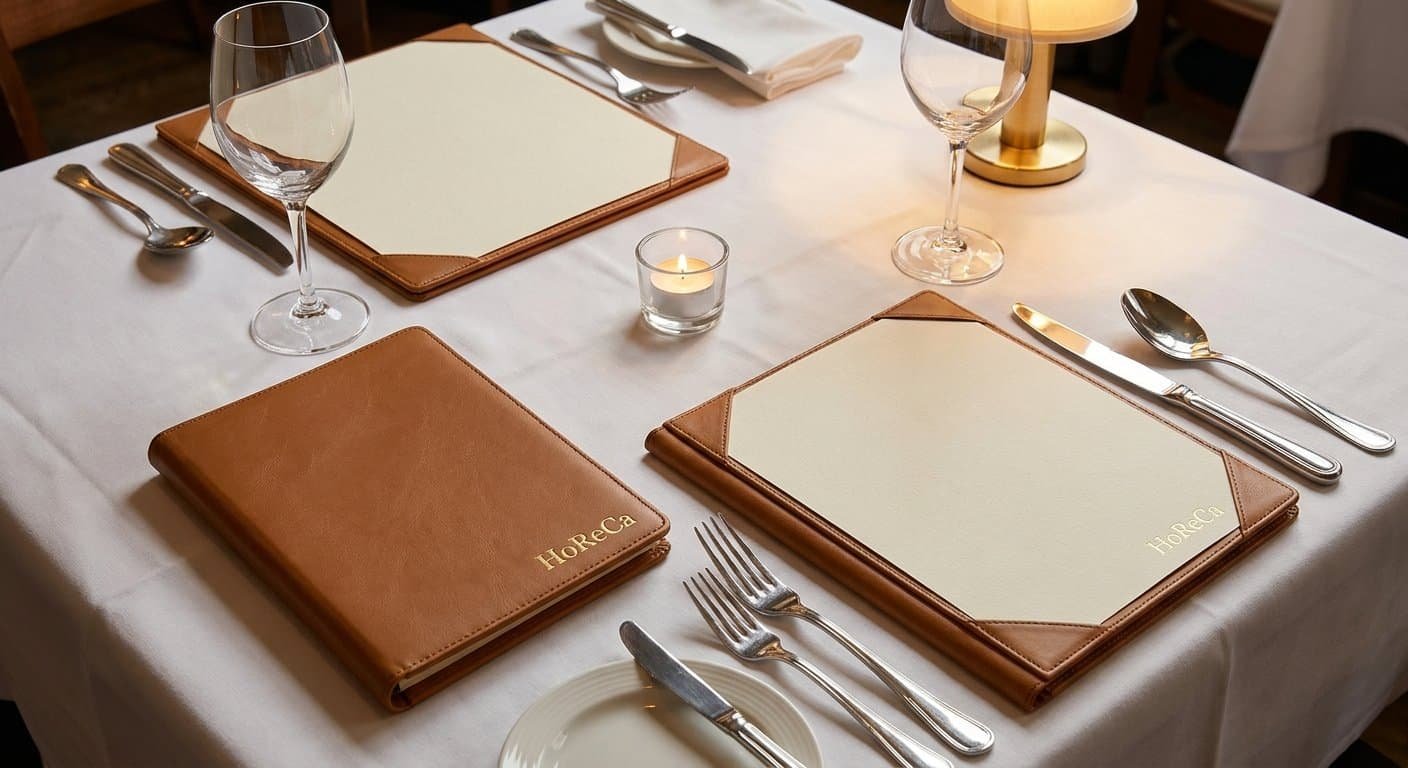
A leather menu cover that costs $20 per piece and lasts eight years costs less per year than a PU cover that costs $10 and lasts two. The difference between those two outcomes is almost entirely maintenance.
Most menu cover deterioration is preventable. Staining, cracking, delamination and mould are the four most common failure modes — and all four are caused by the same two things: wrong cleaning products and damp storage. This guide covers the correct cleaning routine for both genuine leather and PU leather covers, how to handle specific stains, and how to store covers to maximise their service life.
Before You Start: Know Your Material
Genuine leather and PU leather require different care. Using the wrong product on the wrong material accelerates deterioration rather than preventing it.
Genuine leather is a natural material with a porous surface. It absorbs liquids — including cleaning products — which means the wrong cleaner can strip natural oils, dry the leather, cause cracking, or leave permanent staining. Genuine leather benefits from occasional conditioning as well as cleaning.
PU leather has a polyurethane coating on the surface that makes it less absorbent than genuine leather. Most cleaning agents that would damage genuine leather are safe on PU — but solvents and bleach-based products attack the polyurethane coating itself and will cause it to crack or delaminate.
If you are unsure which material your current covers are, check your original order specification. If that is not available, the simplest test: genuine leather has a slight natural smell and, when viewed at the edge, shows a fibrous cross-section. PU leather has no natural smell and shows a uniform layered cross-section at the edge.
Daily Cleaning Routine
Genuine leather covers
After each service: Wipe down with a barely damp cloth — microfibre is ideal — using only water. The cloth should be damp, not wet: excess water left on genuine leather causes watermarking and, over time, promotes mould.
Remove food debris immediately. Sauce, grease and food residue left on genuine leather overnight will stain permanently by the following morning.
Weekly: Use a pH-neutral leather cleaner — available from leather goods retailers or saddlery suppliers. Apply a small amount to a clean cloth, not directly to the leather. Wipe in circular motions, then buff with a dry cloth. This removes accumulated oils from guests’ hands, which build up on genuine leather surfaces and eventually cause discolouration.
Every three to four months: Apply a thin coat of leather conditioner. Conditioner replenishes the natural oils that evaporate from genuine leather over time. Dry, unconditioned leather loses flexibility and begins to crack at the spine and corners — the areas under the most mechanical stress. Apply sparingly with a clean cloth, allow to absorb for fifteen minutes, then buff off any excess.
PU leather covers
After each service: Wipe down with a damp cloth and, if needed, a small amount of mild dish soap or a pH-neutral all-purpose cleaner. PU leather is more resistant to cleaning agents than genuine leather, and the surface can tolerate slightly more moisture.
Rinse with a clean damp cloth after using any soap to prevent residue build-up. Dry with a clean cloth before stacking.
Weekly: No additional cleaning is typically required beyond the daily routine. If covers show scuff marks or fingerprint accumulation, a small amount of PU leather cleaner applied with a soft cloth will restore the surface.
PU leather does not require conditioning. The polyurethane surface does not absorb conditioners, and applying oil-based leather conditioners to PU leather will leave a greasy residue.
Handling Specific Stains
Red wine
Act immediately. Blot — do not rub — with a clean dry cloth to absorb as much liquid as possible before it penetrates the surface.
Genuine leather: after blotting, clean the area with a damp cloth and allow to dry naturally. If a stain remains, a small amount of saddle soap applied with a soft cloth and worked in gently will lift residual staining. Do not use wine stain removers intended for fabric — most contain solvents that damage leather.
PU leather: blot, then clean with a damp cloth and mild soap. PU leather is significantly more resistant to red wine staining than genuine leather because the surface does not absorb liquid.
Grease and cooking oil
Genuine leather: apply a small amount of cornstarch or talcum powder to the stain, leave for several hours to absorb the oil, then brush away and clean with a leather cleaner.
PU leather: wipe with a cloth dampened with a small amount of dish soap. Grease does not penetrate the PU surface and usually wipes away cleanly.
Ink
Ink is difficult to remove from both materials without risking damage to the surface.
Genuine leather: a small amount of isopropyl alcohol on a cotton bud, applied only to the ink mark and not to the surrounding leather, can lift fresh ink. Test on an inconspicuous area first. Old ink stains are usually permanent.
PU leather: the same isopropyl alcohol approach applies, but test first — high concentrations can affect the PU coating.
Mould and mildew
Mould on leather covers is almost always the result of covers being stacked while damp. The mould itself can be cleaned; preventing recurrence requires changing the storage practice.
Genuine leather: wipe with a cloth dampened with a diluted white vinegar solution (one part vinegar to three parts water). Allow to dry completely in open air — not in an enclosed storage space. Apply leather conditioner after the cover has dried fully, as vinegar can dry out genuine leather.
PU leather: wipe with the same diluted vinegar solution. PU leather is less affected by the drying effect of vinegar, but conditioning is not required.
Storage: The Most Important Factor
More covers are damaged by incorrect storage than by any other cause. The correct storage practice is simple:
Never stack covers while damp. This is the single rule that prevents most mould and PU delamination. After a wet service — covers exposed to spills, wiped down, set aside — allow covers to air dry completely before stacking. In a busy kitchen environment, this may mean leaving covers laid out overnight rather than stacking at the end of service.
Store flat or upright, not folded. Covers stored folded under pressure develop a permanent crease along the fold line. Store flat in a pile (genuine leather, maximum 15 covers per pile) or upright in a rack.
Avoid heat sources. Storage near a dishwasher, oven, heat lamp or radiator accelerates drying and cracking in genuine leather and warping in PU leather. A cool, dry storage area away from the kitchen is ideal.
Avoid direct sunlight. UV exposure fades both genuine leather and PU leather. Covers stored or displayed in direct sunlight will show colour fade within months.
Separate covers between services. Covers stacked immediately after service — while still warm from handling — trap moisture between them. A brief period of open storage between services allows heat and moisture to dissipate.
What to Avoid
These products damage both genuine leather and PU leather:
- Bleach-based cleaners — bleach the colour and strip protective coatings
- Acetone or nail polish remover — dissolves PU coating; severely damages genuine leather
- Furniture polish — leaves a silicone residue that attracts dust and darkens genuine leather
- Baby wipes — contain alcohol and fragrance chemicals that dry out genuine leather over repeated use
- Abrasive cloths or scourers — scratch both materials
- Washing machines — ruin both genuine leather and PU leather covers completely
When Maintenance Is No Longer Enough
Even with correct cleaning and storage, covers eventually reach the end of their service life. The indicators that replacement rather than maintenance is the right decision:
- Delamination at corners or spine that cannot be pressed back
- Staining that has penetrated the surface and cannot be removed
- Persistent mould odour that returns after cleaning
- Spine cracking that causes the cover to no longer close flat
- Logo embossing that is no longer legible
- Covers that no longer match each other in colour across the dining room
For guidance on which material to specify for replacement covers and how many to order, see our leather vs PU guide and menu cover quantity guide.
When replacement stock falls below your buffer quantity, request a quote for replacement covers. We hold your specification on file — repeat orders can be placed without re-briefing from scratch, and colour matching to your existing covers is possible if you send a physical reference piece.
Summary: The Care Routine in Brief
| Genuine leather | PU leather | |
|---|---|---|
| After each service | Damp cloth, water only | Damp cloth, mild soap if needed |
| Weekly | pH-neutral leather cleaner | pH-neutral cleaner if needed |
| Every 3–4 months | Leather conditioner | Nothing additional |
| Storage | Dry, flat, away from heat | Dry, flat, away from heat |
| Never use | Bleach, solvents, furniture polish | Bleach, acetone, abrasives |
HoReCa Leather supplies custom leather menu covers from Shiling, Guangzhou. MOQ from 50 pieces, 7-day sampling, DHL delivery to Europe and the Middle East.
Ready to source custom menu covers for your restaurant?
MOQ 50 pieces. Sample in 7–10 days. Quote within 24 hours. Factory-direct from Shiling, Guangzhou.