Leather Menu Covers for Private Members Clubs: A Specification Guide
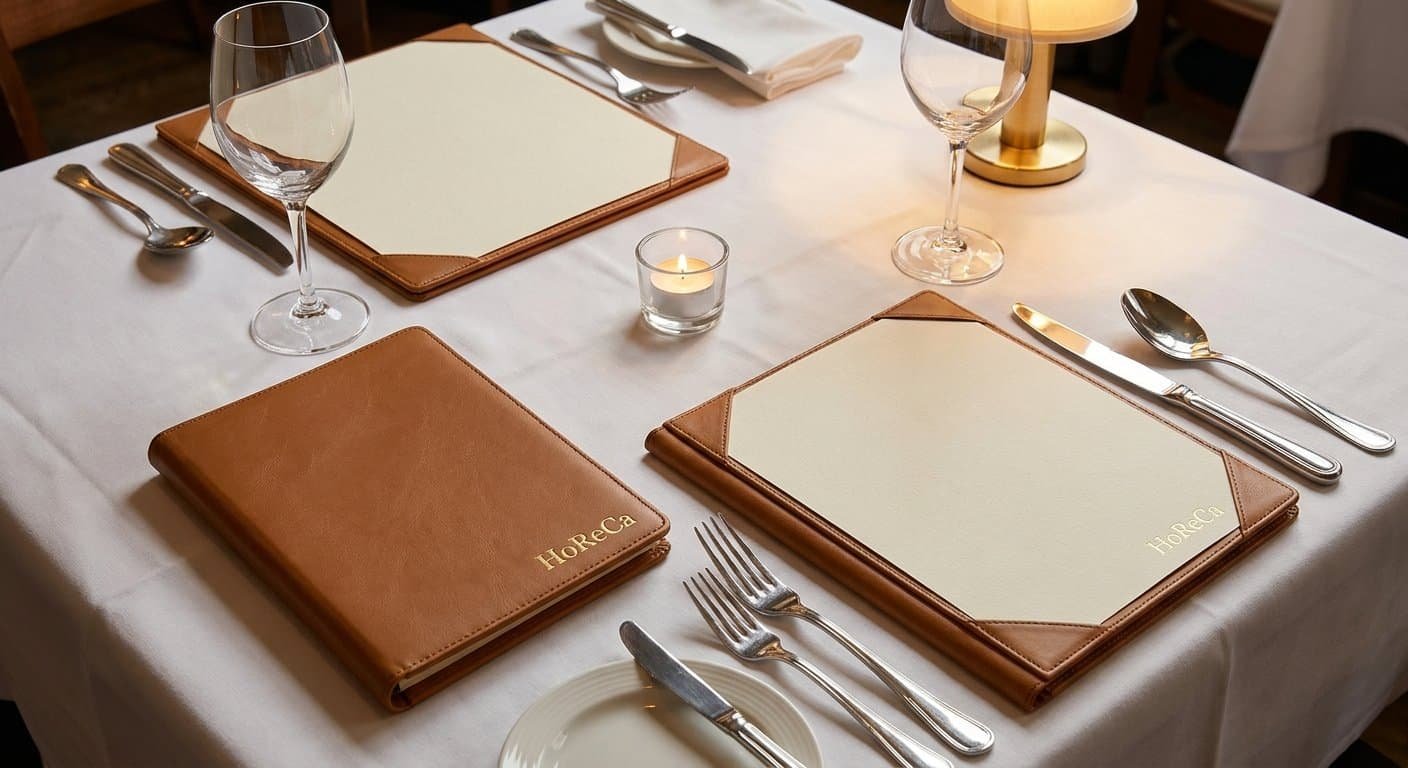
Private members clubs occupy the top of the hospitality quality spectrum. The members paying annual fees in the thousands expect an environment where every detail communicates that their subscription is warranted. A menu cover in a members club is not evaluated against the standard of a good restaurant — it is evaluated against the standard of the club itself, which is usually high.
This guide covers the specific requirements for members club menu covers: why the specification differs from a fine dining restaurant, which products are typically needed across different club areas, and how to achieve the consistency that members notice even when they cannot articulate what they are noticing.
How Members Club Requirements Differ
A private members club is not a single dining environment. Most clubs have several distinct spaces: a formal dining room, a bar and lounge, a private dining suite for member events, a library or reading room, and possibly a terrace or outdoor area. Each space may have its own menu, its own aesthetic and its own service style — but all are part of the same club identity.
The challenge is specifying menu covers that are consistent across all spaces while acknowledging the different functions. A formal dining room cover and a bar lounge cover should be recognisably from the same club, but the bar cover needs to handle more casual use and more frequent handling.
Three things distinguish members club specification from restaurant specification:
Longevity over economy. Members clubs do not replace covers on a cost-driven cycle. They replace covers when the covers no longer meet the standard. This means genuine leather is almost always the correct specification — the investment is justified by a service life measured in years, not months.
Discretion over visibility. Members club branding is understated. The club crest or logo is typically small, blind-embossed, positioned to be noticed rather than announced. Covers that look like branded merchandise — large logos, prominent foil — are inconsistent with the members club aesthetic.
Consistency across years. A cover ordered for the dining room three years ago and a cover ordered for a new private dining suite today should be visually indistinguishable. This requires maintaining a specification record and ensuring reorders match the original exactly.
Specification for Each Club Area
Formal dining room
The highest-specification area in most clubs. Genuine full-grain or top-grain leather in a coordinated set: food menu, wine list, dessert menu and check presenter.
Colour: dark and rich — oxblood, bottle green, navy, black or deep cognac. These colours suit the formal dining aesthetic and develop a distinguished patina over years of service.
Logo: club crest or monogram, blind-embossed, small. Bottom right placement or interior-only placement for maximum discretion.
Format: A4 for the food menu; tall portrait for the wine list if the list is a single-column document; A5 for the dessert menu.
Interior: silk or microfibre lining, ribbon page marker for multi-page menus, card pocket for the club’s membership card or a personal message.
Bar and lounge
The bar handles more volume and more casual use than the formal dining room. High-grade genuine leather rather than full-grain is appropriate here — the quality difference from the dining room is negligible to members, but the durability difference over years of bar use is significant.
Cocktail list and spirits list in a tall portrait format that sits neatly beside a glass. Check presenters for bar bills in the same leather, with a magnetic closure to prevent the presenter from falling open when carried across a busy bar.
Same leather colour as the dining room — the bar is part of the same club — but the logo treatment can be slightly more visible than in the dining room, where the logo is at its most discreet.
Private dining suite
Private dining rooms in members clubs are used for member events, board dinners and private functions. The menu covers for these spaces are typically custom to each event — a printed insert with the evening’s menu, presented in a leather cover embossed with the club crest.
The leather cover for private dining is often the same specification as the formal dining room — the same colour, the same logo treatment — so that members hosting guests in the private suite are presenting the same quality they experience in the main dining room.
Some clubs commission a separate set of covers for private dining that are more elaborate than the main dining room specification — a deeper emboss, a lining in the club’s colours — to signal that the private suite is a premium experience within the premium experience.
Library and reading room
Clubs with a library or reading room may present a drinks menu or a light snacks menu in these spaces. The specification here is typically a simple single-fold cover in a smaller format — A5 — in the same leather as the bar, with the logo at its most discreet.
Outdoor and terrace
Outdoor covers need to withstand UV exposure and humidity. High-grade PU leather is the practical choice for outdoor areas even in a members club — genuine leather deteriorates faster outdoors than any other environment. Specify a colour that coordinates with the indoor specification; the material difference is not visible to members unless they are specifically looking for it.
The Club Crest: Embossing Considerations
Members clubs almost universally use a crest rather than a wordmark logo. Crests present specific embossing challenges:
Detail level. Traditional heraldic crests contain fine lines, hatching and small text that compress at small embossing sizes. For a crest embossed at 4–5 cm, a simplified version — the shield outline and primary charge, without fine hatching detail — produces a cleaner impression than the full crest at that size.
The die. A complex crest requires a more detailed embossing die, which takes longer to produce and costs more than a simple wordmark die. Allow for this in the timeline — die production for a detailed crest can add five to seven working days to the sample lead time.
Foil vs blind emboss. A blind-embossed crest on dark leather can be difficult to read in low lighting. For clubs with dimly lit dining rooms, a very fine gold foil on a blind-embossed base — the foil catching the light, the relief adding depth — can be more legible than blind emboss alone without looking commercial. We can produce a sample showing both options for comparison.
For detailed guidance on preparing crest artwork for embossing, see our logo embossing guide.
Maintaining Consistency Over Time
Members clubs replace covers infrequently but need perfect consistency when they do. The practical requirements:
Keep the specification on file. After the first order, we hold your specification — leather grade, colour, logo die, format dimensions, interior specification — and use it for every subsequent order. You do not need to re-brief from scratch.
Keep a physical reference sample. We recommend retaining one cover from every order as a reference sample. When the next order is placed, the reference sample is used to confirm colour match before bulk production.
Order conservatively more than you need. For a formal dining room with 25 tables, order 35 covers rather than 30. The additional ten covers, stored correctly, will last for years and guarantee you have replacements available without requiring a reorder when one or two covers need replacing.
Reorder before stock runs out. Our production timeline is four to six weeks from order to delivery for a repeat order. For a members club that replaces covers one or two at a time, a small standing stock prevents the situation where a damaged cover remains in service because the replacement has not arrived.
Quantity Planning
Members clubs typically have lower table counts than restaurants of equivalent prestige. A formal dining room of 20 tables, a bar of 15 seats and a private dining suite of 12 seats is typical.
Apply the standard formula: table count × 1.2 for dining room covers; seat count × 0.6 for bar covers (not every bar seat needs its own cover simultaneously).
For a club of this size, the 50-piece MOQ across all areas may require combining multiple products in one order — dining room covers, bar covers and check presenters together — to reach the threshold. We can advise on the most practical way to structure the order for a smaller club.
For the full quantity calculation methodology, see our menu cover quantity guide.
Ready to Specify?
For members club enquiries, send us your club crest or logo in vector format, the leather colour reference or a physical swatch from an existing cover you want to match, a list of the spaces and products required, and your required delivery date.
Use the quote form or contact us directly. We reply within 24 hours with pricing, a production schedule and a digital proof showing the crest embossed on each product.
Browse our leather menu covers, wine list covers and check presenters for format and colour reference.
HoReCa Leather supplies custom leather menu covers for private members clubs from Shiling, Guangzhou. Genuine leather in all grades, crest embossing, coordinated multi-area sets. MOQ from 50 pieces, 7-day sampling, DHL delivery to Europe and the Middle East.
Ready to source custom menu covers for your restaurant?
MOQ 50 pieces. Sample in 7–10 days. Quote within 24 hours. Factory-direct from Shiling, Guangzhou.