Leather Goods for Boutique Hotels: A Procurement Guide for Independent Properties
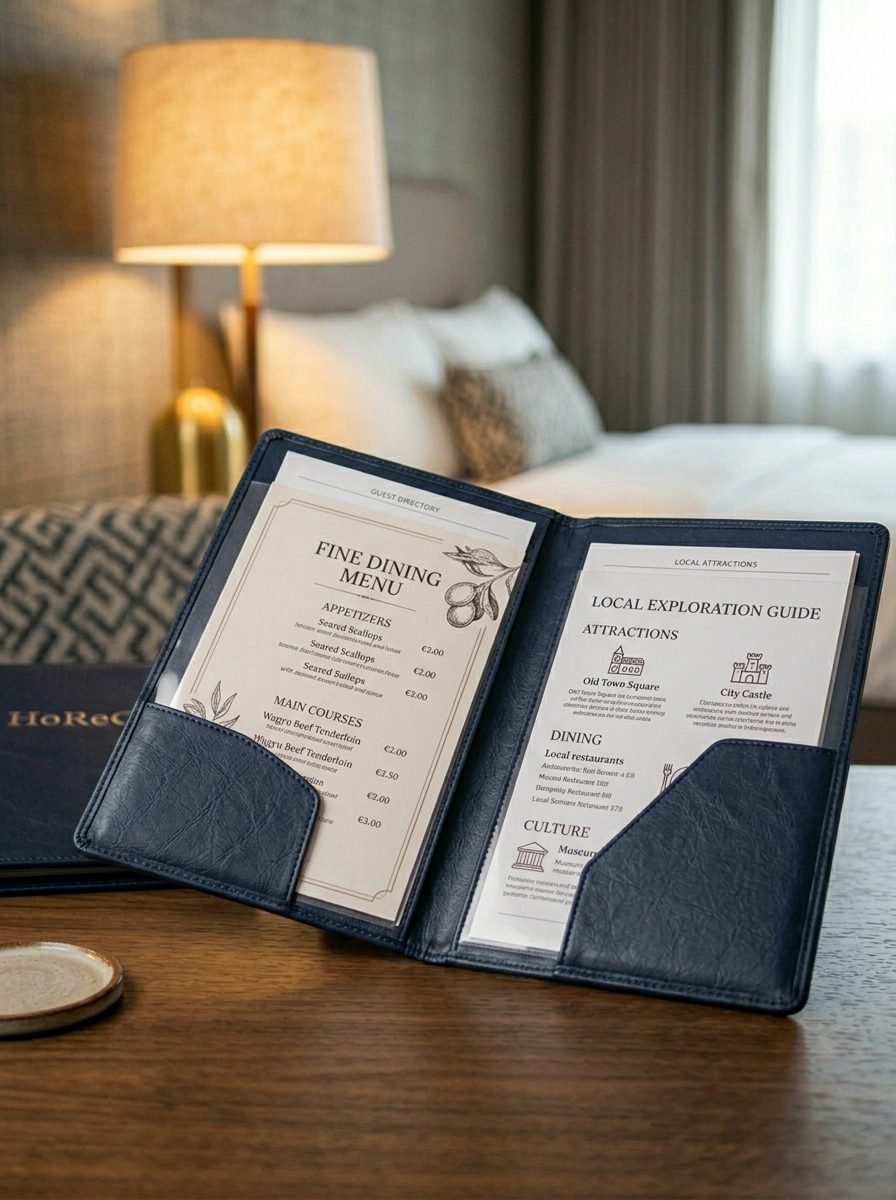
Boutique hotels operate under different constraints from branded chain properties. There is no FF&E department, no global procurement team, no pre-approved supplier list. The general manager or owner makes sourcing decisions directly — often while also managing operations, staffing and guest relations.
The leather goods decision — key card holders, in-room compendiums, restaurant menu covers — is typically made once, when the property opens or refurbishes, and then largely forgotten until something wears out or a guest comments on the condition of a cover.
This guide is written for boutique hotel owners, general managers and operations managers sourcing leather goods for the first time or switching from a current supplier. It covers what to prioritise, how to manage the process without a dedicated procurement team, and what makes boutique hotel sourcing different from chain hotel procurement.
What Makes Boutique Hotel Procurement Different
Smaller quantities. A 30-room boutique hotel needs approximately 45 key card holders, 33 compendiums and 36 menu covers for a 30-table restaurant. These quantities are at or just above the 50-piece MOQ — manageable for a specialist supplier but below the threshold where large Chinese factories take the order seriously.
Stronger design identity. Boutique hotels often have a more distinctive aesthetic than branded chain properties — a specific colour palette, a graphic identity, a material story that runs through the property. Leather goods need to be specified to match this identity precisely rather than to a generic brand standard.
No dedicated FF&E resource. The person making the leather goods decision at a boutique hotel is usually not a procurement specialist. They need a supplier who can guide the specification process, not one who requires a fully formed brief before engaging.
Longer decision cycles. Boutique hotel decisions move more slowly than corporate procurement — one person making decisions between twenty other responsibilities. A supplier who requires rapid decision-making will lose boutique hotel buyers to one who is willing to work at the property’s pace.
Higher sensitivity to quality inconsistency. In a 30-room property, a guest who encounters a worn key card holder or a mismatched menu cover notices it more acutely than in a 500-room hotel where individual items are less visible. Quality standards need to be higher per-unit than the volume would suggest.
The Priority Order for a New Opening
If you are opening a boutique hotel and need to decide which leather goods to prioritise, this is the recommended sequence:
First priority: key card holders The first physical touch. Presented at check-in before anything else. See our key card holder guide for full specification details.
Second priority: in-room compendium The primary branded reference in the room. Guests consult it throughout their stay. See our compendium guide for format and specification options.
Third priority: restaurant menu covers and check presenters If the property has a dining outlet, these are the next most visible branded items. See our leather menu covers guide and check presenter guide.
Fourth priority: welcome gift set A leather welcome kit — key card holder, luggage tag, passport holder — positioned as a guest gift rather than an operational amenity. Appropriate when the property wants to create a memorable check-in moment. See our hotel leather goods guide for welcome kit configurations.
Lower priority at opening: desk pad, notebook covers, conference folios These are meaningful additions but not essential at opening. Add them in the first reorder cycle once the core amenity set is established.
Colour and Material Specification for a Boutique Property
The colour and material decision at a boutique hotel is more design-sensitive than at a chain property. A few practical approaches:
Match to your interior dominant colour. If your property has a dominant upholstery or furniture colour — a deep teal, a warm cognac, a slate grey — leather goods in the same or closely related colour create a coherent material story. Request a Pantone reference from your interior designer and we will match the leather colour.
Use black or dark brown as a safe default. If your interior palette is varied and you cannot identify a single dominant leather colour, black or dark brown works with virtually every interior scheme. It reads as considered without competing with other design elements.
Genuine leather for any item a guest touches at the moment of arrival. The key card holder and welcome kit should be genuine leather regardless of the property tier — these items form the first physical impression. In-room and restaurant items can be specified at a lower material grade if budget requires.
Request a physical sample before confirming colour. For boutique hotel specifications where the colour must match the interior precisely, a physical sample reviewed on-site under the property’s actual lighting is essential. Colour looks different under different light sources; a sample approved in a supplier’s photograph or in an office environment can disappoint when installed in a warm, ambient-lit hotel room.
Managing the Process Without a Procurement Team
For a boutique hotel operator managing the leather goods procurement alongside ten other priorities, the process needs to be simple and guided. What to expect when working with us:
Step 1: Send a brief sketch of what you need. You do not need a formal RFQ. An email or message saying “30-room boutique hotel, opening in four months, need key card holders and compendiums, thinking dark green leather to match our interior” is enough to start.
Step 2: We send a guided questionnaire. We ask the specific questions needed to build a complete specification — insert dimensions, preferred format, logo file status, timeline. You answer at your pace; we do not require everything in a single response.
Step 3: Digital proof and sample. Once the specification is confirmed, we send a digital proof within 24 hours and a physical sample within seven working days. You review both at your property.
Step 4: Bulk order after sample approval. Production begins after you confirm the sample. We manage the production timeline and keep you informed at key stages.
Step 5: DHL delivery to your property address. Direct delivery to the hotel, timed for your opening or refurbishment schedule.
Typical Boutique Hotel Opening Order
For reference, a typical boutique hotel with 35 rooms and a 25-table restaurant:
| Product | Quantity | Notes |
|---|---|---|
| Key card holders | 55 | 35 × 1.5 + small buffer |
| In-room compendiums | 40 | 35 × 1.1, rounded to MOQ |
| Menu covers (restaurant) | 50 | 25 × 1.2, rounded to MOQ |
| Check presenters | 50 | 25 ÷ 2 + buffer, rounded to MOQ |
| Welcome kit (key card + luggage tag + passport holder) | 50 sets | For loyalty/VIP gifting stock |
Total: approximately 245 pieces across five product types. All produced in a single run from the same leather batch.
For the full quantity calculation methodology, see our menu cover quantity guide and hotel sourcing guide.
Timeline for a Boutique Hotel Opening
| Weeks before opening | Action |
|---|---|
| 12 weeks | Submit initial brief |
| 10–11 weeks | Receive and approve digital proof |
| 9–10 weeks | Receive physical sample; review on-site |
| 8–9 weeks | Approve sample; confirm bulk order |
| 3–4 weeks | Production complete; pre-shipment photos |
| 1–2 weeks | DHL delivery to property |
For a property opening in under ten weeks, the timeline is tight but achievable if the logo is finalised and the colour decision is made immediately. Contact us directly rather than using the quote form for urgent opening timelines — we can advise on what is achievable and what needs to flex.
Ready to Start?
Use the quote form to send your brief — property size, opening date, preferred colour direction and logo file if available. We will guide the specification process from there.
Browse our hotel leather goods range for product reference, or read our hotel sourcing guide for a detailed procurement walkthrough.
HoReCa Leather supplies custom leather goods for boutique hotels from Shiling, Guangzhou. MOQ from 50 pieces, guided specification process for independent properties, 7-day sampling, DHL delivery to Europe and the Middle East.
Ready to source leather hotel amenities for your property?
MOQ 50 pieces. Sample in 7–10 days. Quote within 24 hours. Factory-direct from Shiling, Guangzhou.