Vegan Leather Menu Covers and Hospitality Goods: A Buyer’s Guide
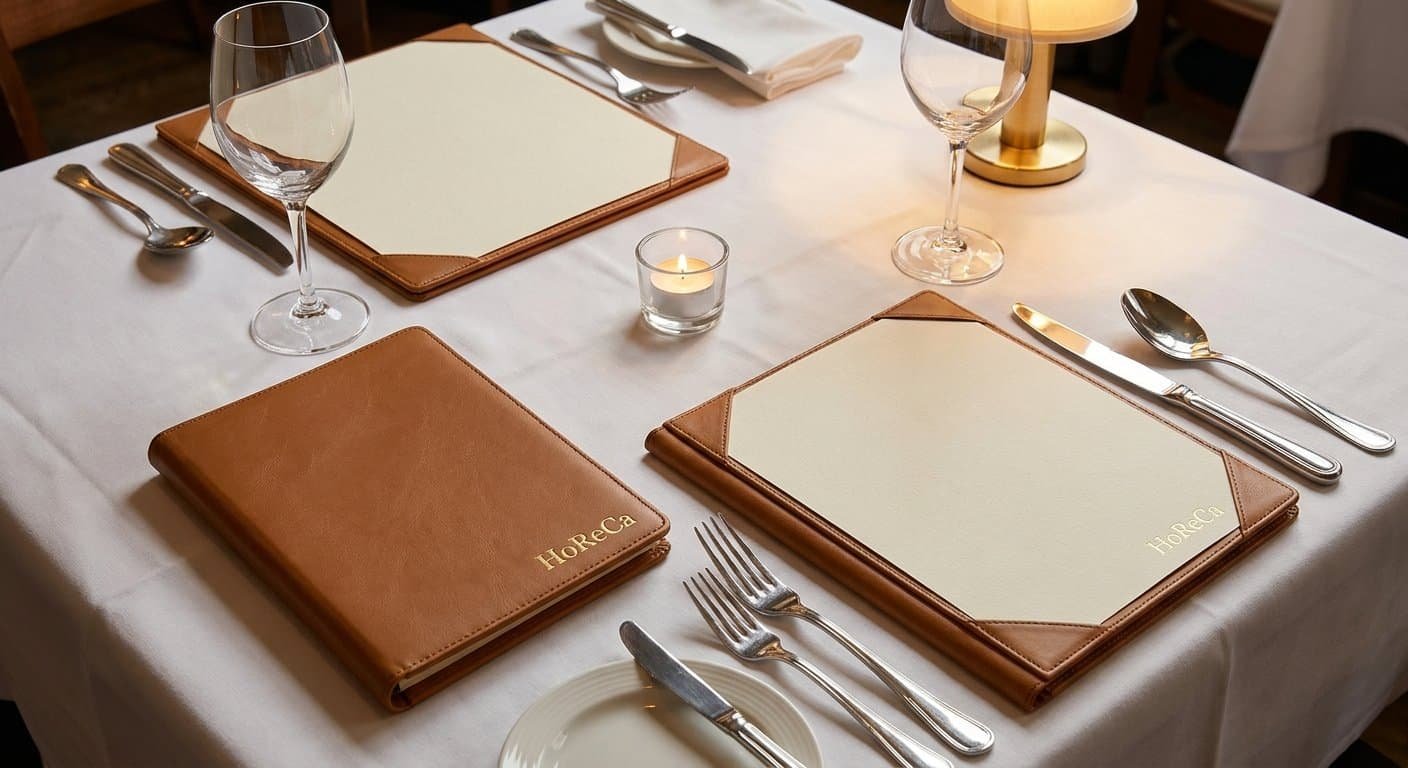
Vegan leather menu covers have moved from a niche request to a standard option in the hospitality procurement market. Plant-based restaurants, sustainability-focused hotel brands, B-Corp certified companies and venues with animal-free dining concepts all specify vegan leather as a matter of brand consistency.
This guide covers what vegan leather actually means in the context of hospitality goods, which materials are available, how they compare to genuine leather and standard PU, and what to look for when specifying vegan leather for restaurant and hotel use.
What “Vegan Leather” Actually Means
The term vegan leather covers a wide range of materials — some meaningfully different from standard PU leather, some essentially the same product with a different marketing label.
Standard PU leather (polyurethane): contains no animal products by definition. PU leather is already vegan. If a supplier offers “vegan leather” at the same price as their standard PU leather, they are most likely offering the same material with a different label. This is not necessarily dishonest — PU is indeed animal-free — but it is worth understanding that the term “vegan leather” is not a quality designation.
High-grade microfibre vegan leather: a non-woven microfibre base material coated with polyurethane or a similar polymer. The microfibre structure more closely resembles the fibre structure of genuine leather than standard PU, giving a better hand-feel, better durability and more natural appearance. This is the most common genuine upgrade over standard PU when buyers specify vegan leather.
Bio-based and plant-derived leathers: materials derived from plant sources — cactus leather (Desserto), apple leather (Frumat), mushroom leather (Bolt Threads/Mylo), cork leather, pineapple leaf leather (Piñatex). These materials are at various stages of commercial availability. Some (cork, pineapple leaf) are commercially available in hospitality quantities; others (mushroom leather) remain high-cost and limited in scale. All are genuinely plant-based and carry more meaningful sustainability credentials than PU.
For most hospitality buyers, the practical choice is between high-grade microfibre vegan leather and standard PU leather labelled as vegan. The bio-based alternatives are worth considering for properties with a serious sustainability narrative, but at higher cost and more limited availability.
Vegan Leather Options We Supply
High-grade microfibre vegan leather Our primary vegan leather offering for hospitality use. The microfibre base provides better dimensional stability than standard PU — covers hold their shape longer, the edges are less prone to delamination, and the surface handles repeated handling more gracefully. Texture options include smooth, pebbled grain and a brushed suede-like finish.
Price: approximately 15–25% more than standard PU at the same MOQ. Lifespan: three to five years, compared to two to four years for high-grade PU.
Cork leather A natural material made from cork oak bark — genuinely plant-based, biodegradable, and with a distinctive texture that communicates sustainability visually. Cork leather is appropriate for venues where the vegan and sustainable credential is a visible part of the brand identity — the material announces itself.
Durability is lower than microfibre — cork leather covers show wear faster than microfibre or PU in high-handling environments. Best for fine dining or wine bar contexts where covers are handled carefully.
Price: comparable to genuine leather at similar quality levels.
Pineapple leaf leather (Piñatex) Made from fibres extracted from pineapple leaves — a by-product of pineapple farming. Piñatex has an established commercial supply chain and is used by a number of fashion and hospitality brands. It has a distinctive texture — similar to a woven textile with a leather-like surface — and is certified by the manufacturer as vegan and sustainably sourced.
Available in limited colours; dyeing options are narrower than for PU or microfibre. Confirm colour availability before specifying.
Price: higher than microfibre, comparable to or slightly below genuine leather.
How Vegan Leather Compares for Hospitality Use
| Genuine leather | Microfibre vegan | Standard PU | Cork | |
|---|---|---|---|---|
| Animal products | Yes | No | No | No |
| Lifespan | 5–10 years | 3–5 years | 2–4 years | 2–3 years |
| Hand-feel | Best | Good | Acceptable | Distinctive |
| Spill resistance | Good | Very good | Excellent | Good |
| Embossing quality | Excellent | Good | Good | Limited |
| Price | Highest | Mid-high | Low-mid | Mid-high |
| Best for | Fine dining, luxury hotels | Most hospitality contexts | High-volume casual | Sustainability-narrative venues |
For most vegan-specified hospitality buyers, microfibre vegan leather offers the best balance of durability, appearance and verifiable animal-free credentials.
Communicating Sustainability Claims
Buyers who specify vegan leather for sustainability reasons — not only animal welfare — should understand the environmental picture honestly.
Standard PU leather uses petrochemical inputs and is not biodegradable. It has no animal content, but its environmental footprint includes the production of the polyurethane polymer and the chemical processes involved in coating and finishing.
Microfibre vegan leather has a similar profile — better durability than standard PU reduces the replacement frequency (and therefore the total material consumption over time), but the material itself is still petrochemical-derived.
Cork and pineapple leaf leathers have more defensible sustainability credentials: cork is harvested from living trees without felling them, and Piñatex uses agricultural waste fibre. Both are biodegradable to varying degrees.
For properties making sustainability claims in their marketing — a hotel with a sustainability certification, a restaurant with a B-Corp designation — we recommend specifying a material whose credentials can be verified and documented. We can provide material specification sheets and, for Piñatex, brand certification documentation.
Logo Embossing on Vegan Leather
Logo embossing on vegan leather follows the same process as on genuine leather or standard PU, with some material-specific notes:
Microfibre vegan leather: accepts blind deboss and foil stamping well. The microfibre surface produces a clean, sharp impression comparable to genuine leather. Gold and silver foil adhere reliably.
Cork leather: blind deboss is possible but produces a softer impression than leather or microfibre — the cork compresses under the die but does not hold the impression as crisply. Laser engraving is the most effective branding method for cork, producing a clean contrast between the engraved and natural surface. Foil stamping is possible on some cork grades.
Piñatex: screen printing or UV printing produces better results than embossing on Piñatex — the fibrous surface does not take an embossed impression as cleanly as leather or microfibre. Confirm with us at the brief stage.
For all other logo guidance, see our logo embossing guide.
Vegan Leather for Hotel Properties
Sustainability-focused hotel brands — those pursuing LEED certification, Green Key accreditation or similar environmental designations — increasingly specify vegan or bio-based leather for their in-room amenities and F&B leather goods as part of a broader materials policy.
For these properties, we recommend: – Microfibre vegan leather for menu covers, check presenters and in-room compendiums — the best combination of performance and verifiable vegan credentials – Cork leather for selected accent pieces — luggage tags or key card holders — where the distinctive material communicates the sustainability story visibly – Material specification documentation provided with each order for inclusion in sustainability reporting
For hotel properties ordering vegan leather goods as part of a full hotel leather goods programme, all vegan leather products can be produced in a single run coordinated with any genuine leather products in the same order.
Ready to Specify Vegan Leather?
Use the quote form to tell us your product, quantity, preferred vegan leather type and sustainability documentation requirements. We will confirm material availability, provide a quote and arrange a sample in your specified material.
For material comparison guidance, see our leather vs PU guide — the same framework applies when comparing vegan options.
HoReCa Leather supplies vegan leather menu covers and hospitality goods from Shiling, Guangzhou. Microfibre, cork and Piñatex options available. MOQ from 50 pieces, 7-day sampling, DHL delivery to Europe and the Middle East.
Ready to source custom menu covers for your restaurant?
MOQ 50 pieces. Sample in 7–10 days. Quote within 24 hours. Factory-direct from Shiling, Guangzhou.