How to Choose Leather Menu Covers: A Size Guide for Restaurants
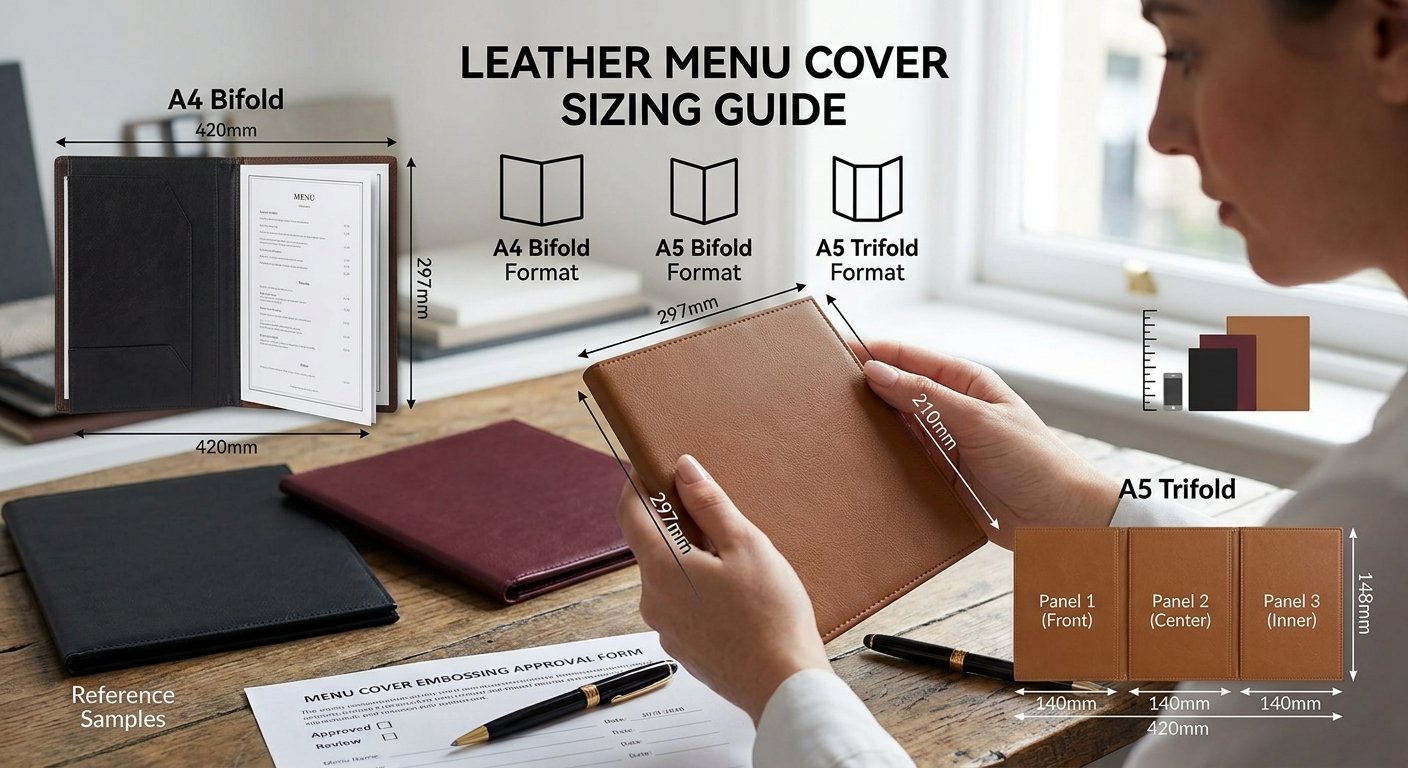
Choosing the wrong menu cover size is the single most common — and most expensive — mistake restaurant owners make when ordering leather menus. A cover that’s too small forces awkward folding or cropped page layouts. One that’s too large feels unwieldy at the table and wastes leather on every piece you order.
This guide walks through the actual page sizes restaurants use, how to measure for a custom fit, and which fold format suits different menu lengths — so you order the right size the first time, whether you’re ordering 20 covers for a single dining room or 200 for a multi-location group.
1. Standard Menu Page Sizes
Before choosing a cover, you need to know what page size your printed menu inserts will be. Almost every restaurant menu in Europe, the Middle East, and North America falls into one of these standard formats:
| Size name | Dimensions | Typical use | Region |
|---|---|---|---|
| A4 Most common | 210 × 297 mm | Full menus, wine lists, fine dining | Europe, Middle East |
| A5 | 148 × 210 mm | Compact menus, breakfast/lunch cards, cafés | Europe, Middle East |
| US Letter | 216 × 279 mm | Full menus | North America |
| US Half-Letter | 140 × 216 mm | Compact menus, drink lists | North America |
| Custom / Square | Any, often 200 × 200 mm | Design-led concept restaurants, cocktail bars | Global |
Always measure your actual printed page — not the “standard” name. Printers sometimes trim A4 to slightly different finished dimensions. Send us your exact page size (or a sample printed page) and we cut the cover insert pocket to fit with a small margin, typically 3–5 mm on each side, so pages sit securely without curling at the edges.
2. Cover Format: Single Panel, Bifold, Trifold, or Z-Fold
The page size tells you the insert dimensions. The fold format determines how many pages the cover can hold and how it behaves on the table.
Single Panel (Flat Cover)
One flat leather panel with a single insert pocket, front and back. Holds 2–4 pages depending on insert thickness. Best for short menus — daily specials, drink lists, or breakfast menus where the full offering fits on one or two sheets. Most compact on the table.
Bifold (Book Style)
Two panels that open like a book. The most common restaurant menu format — holds 4–8 pages comfortably (2 pages per inside face, plus inserts on front and back covers if needed). Works for A4, A5, and Letter sizes. Recommended starting point if you’re unsure which format fits your menu length.
Trifold
Three panels. Holds 6–12 pages across all panel faces. Common for restaurants with a main menu plus a separate wine or dessert section that needs its own dedicated panel. Takes up more table space when fully open — confirm your table size accommodates this before ordering.
Z-Fold (Accordion)
Folds in a zigzag pattern rather than a simple book fold. Often used for wine lists or tasting menus presented as a continuous sequence rather than discrete pages. Less common for main food menus due to the unfamiliar handling, but distinctive for concept restaurants wanting a different table presence.
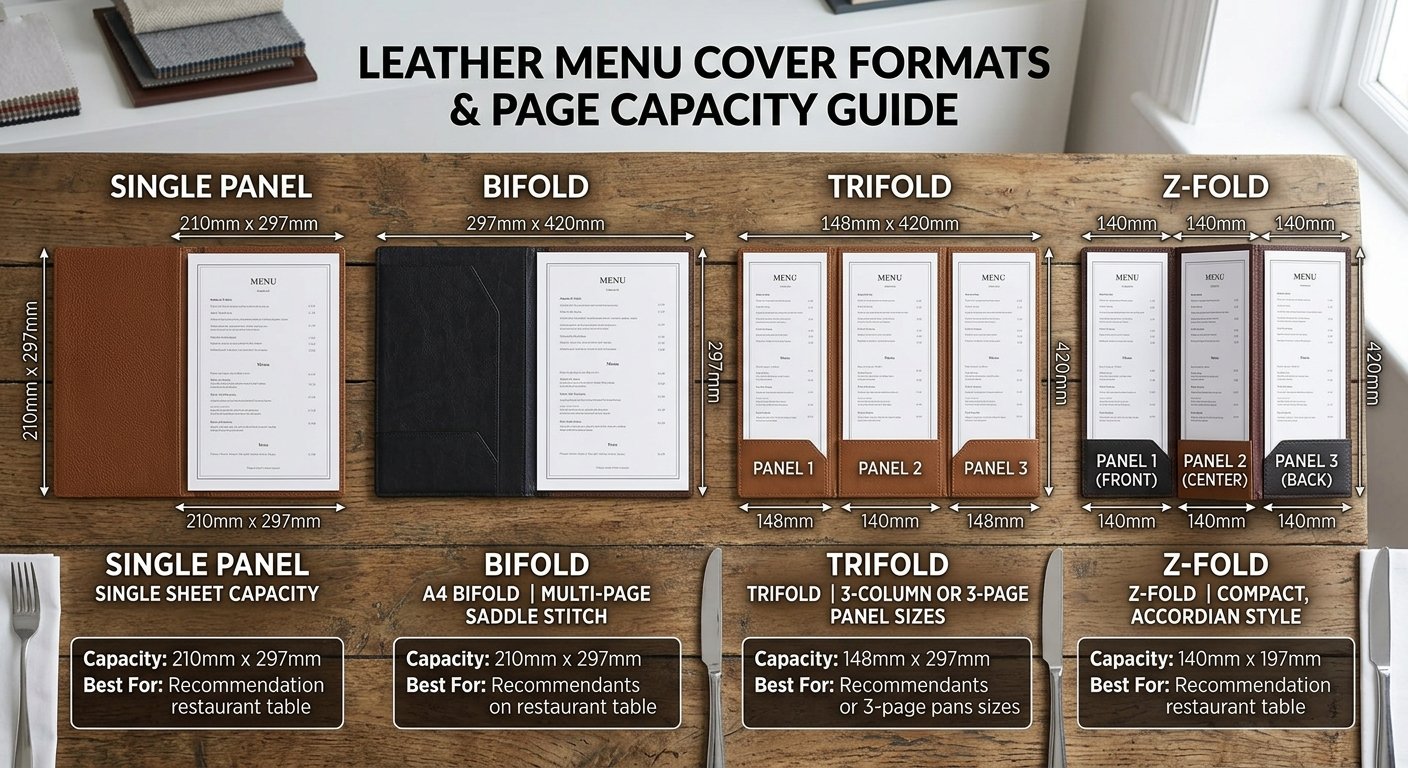
Four leather menu cover formats laid open side by side on a restaurant table: single panel, bifold, trifold, and Z-fold — showing relative size and page capacity.
3. Matching Page Count to Cover Format
Use this as a starting reference. Page count includes printed inserts on both sides of each panel face.
| Your menu length | Recommended format | Page capacity | Insert pocket type |
|---|---|---|---|
| 1–2 pages (daily specials, drinks) | Single panel | 2–4 pages | Open-top sleeve, both sides |
| 3–6 pages (standard à la carte) | Bifold Most ordered | 4–8 pages | Corner slots or full sleeve |
| 7–10 pages (extensive menu + wine list) | Trifold | 6–12 pages | Corner slots per panel |
| 10+ pages or full multi-course tasting menu | Multi-ring binder style | 12+ pages, replaceable | Ring or screw-post binding |
If your menu changes frequently (seasonal items, daily specials, price updates), prioritise an insert format that allows easy page swaps — corner slots or open-top sleeves — over a sealed pocket that requires removing the entire cover to update one page.
4. Custom and Non-Standard Sizes
Roughly 20% of our restaurant orders are custom sizes — usually for one of these reasons:
- Branded square or non-standard proportions — concept restaurants and cocktail bars wanting a distinctive table presence that doesn’t match any printer’s standard page size.
- Matching an existing menu design — restaurants that already have printed menus in a specific size and need a cover built around the existing print run rather than reprinting.
- QR-code-only “menu” with a small card insert — increasingly common since 2023; a compact leather holder for a single small card rather than a full multi-page menu.
- Oversized format for high-end tasting menus — some fine dining concepts use deliberately oversized covers (e.g. 250 × 350 mm) as a design statement.
Custom sizes require a minimum order of 30 pieces and add 3–5 days to the pattern-cutting stage before sampling can begin. There is no extra charge for custom sizing itself — only the standard sample fee applies. Send us your exact dimensions (or a physical page) with your inquiry and we confirm feasibility within 24 hours.
5. How Cover Size Affects Material Yield and Price
Larger covers and multi-panel formats use proportionally more leather, which is the main driver of price differences between formats — not the leather grade itself.
| Format (A4 size) | Approx. leather area | Ex-factory price (top-grain) | MOQ |
|---|---|---|---|
| Single Panel | ~620 cm² | €7–€11 | 30 pcs |
| Bifold | ~1,240 cm² | €11–€16 | 30 pcs |
| Trifold | ~1,860 cm² | €15–€21 | 30 pcs |
| Ring Binder | ~1,500 cm² + hardware | €19–€28 | 30 pcs |
Choosing A5 instead of A4 for a bifold typically reduces leather area — and price — by roughly 30%. If your menu content fits comfortably on A5 pages, this is the single biggest cost lever available before considering material grade changes.
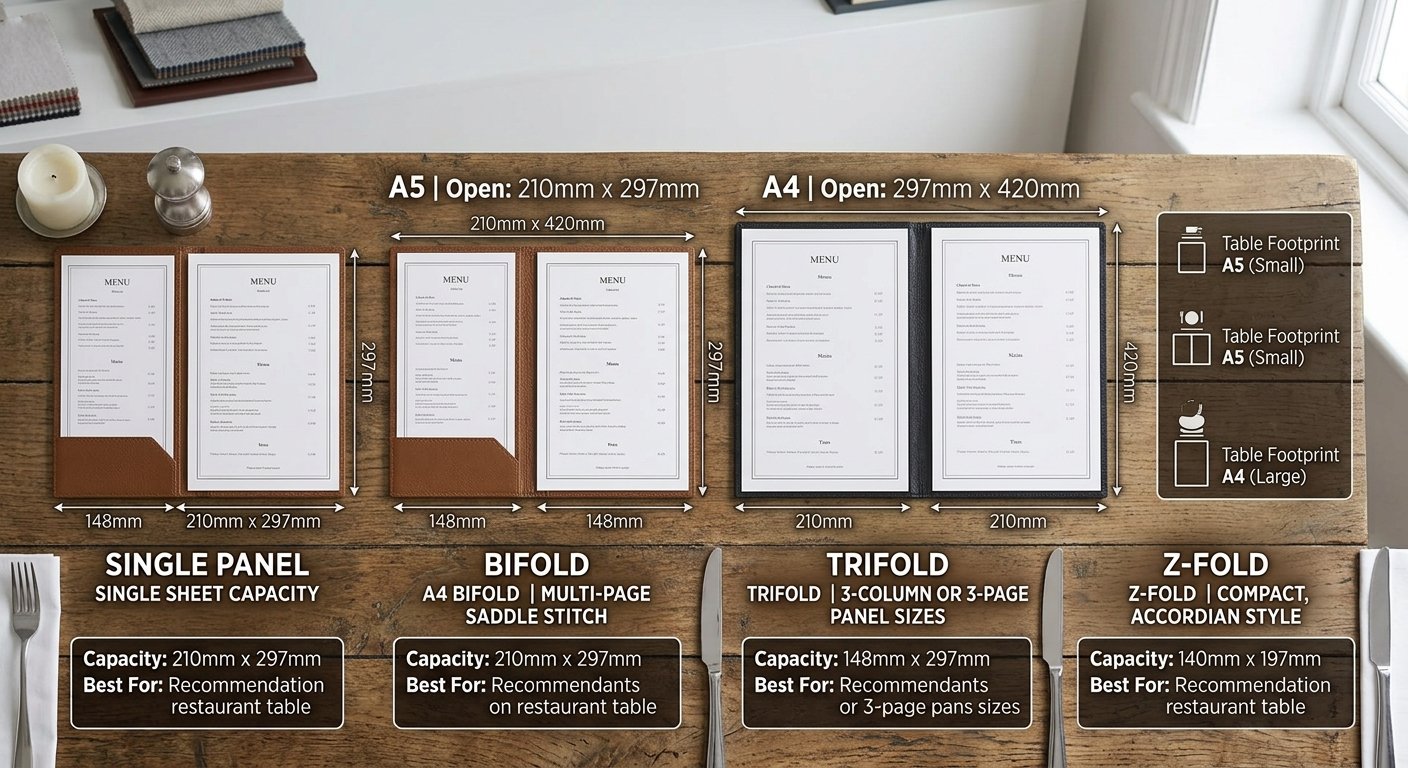
Size comparison: A5 bifold menu cover next to A4 bifold menu cover on a restaurant table, showing the proportional difference in table footprint.
6. Quantity Planning by Restaurant Type
Single-Location Independent Restaurant
Order enough for every table plus 15–20% spare for damage, spills, and rotation while covers are being cleaned. A 40-table restaurant typically orders 50–60 covers.
Multi-Location Group
Order centrally for all locations in one production run to guarantee colour and logo consistency across the brand, then distribute. This also unlocks volume pricing at 200+ pieces that a single location ordering alone wouldn’t reach.
Seasonal or Pop-Up Menus
Consider a separate smaller-format cover (single panel) for seasonal inserts rather than reprinting your main bifold menu. Lower cost per piece and avoids retiring covers that are otherwise still in good condition.
7. Sampling and Sizing Confirmation
Before placing a bulk order in a new size or format, always confirm fit with a sample.
Total timeline for a new size or format: 6–7 weeks first order. Reorders in the same size and format: 3–4 weeks.
Ready to order leather
menu covers in the right size?
MOQ 30 pieces. Sample in 6–8 days. Quote within 24 hours. Factory-direct from Shiling, Guangzhou.