Leather Menu Covers for Wine Bars: A Buyer’s Guide
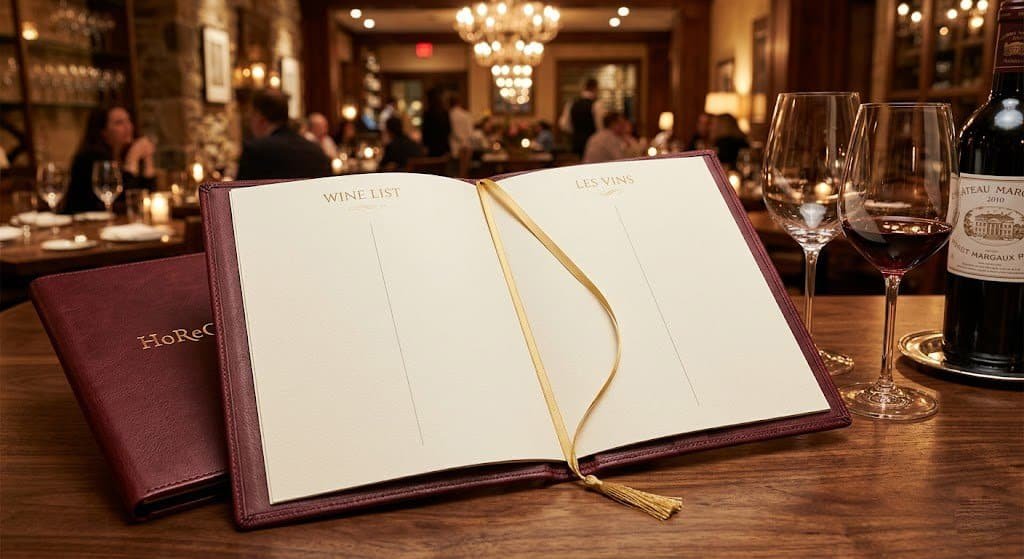
Wine bars have different requirements from full-service restaurants — and those differences matter when specifying leather menu covers.
The menu format is usually simpler: a wine list, possibly a small food menu, sometimes a daily specials card. The table footprint is smaller. The service style is more informal. But the aesthetic expectations are often higher than a casual restaurant — wine bars attract guests who notice the details, and a worn or generic menu cover registers as a mismatch with an otherwise considered environment.
This guide covers the specific requirements for wine bar menu covers: the right formats, sizes, materials and coordinating products for a venue where wine is the primary focus.
How Wine Bar Menu Requirements Differ
A full-service restaurant typically needs one type of cover: a menu cover for the food menu, used throughout service. A wine bar usually needs two or three:
The wine list cover — the primary document. In a serious wine bar, this may be a multi-page booklet with tasting notes, producer information and vintage detail. In a simpler venue, it may be a single folded sheet updated weekly.
The food menu cover — smaller and secondary to the wine list. Many wine bars offer a short menu of cheese, charcuterie, small plates or bar snacks. This menu is often shorter than a full restaurant menu, which affects the cover size.
The daily specials or by-the-glass card — some wine bars present a separate card for the day’s open bottles or featured pours. This is typically a smaller, lighter format than the main wine list.
The challenge is specifying all three in a coordinated set that looks intentional rather than assembled from different orders placed at different times.
Wine List Cover Formats
The wine list format determines the cover. Before specifying a cover, confirm your wine list format:
Single folded sheet (most common for smaller wine bars) A single sheet of A4 or US Letter paper folded in half produces an A5 booklet. The cover for this format is typically A5 closed — compact, easy to handle at a bar or small table.
Multi-page booklet A wine list with multiple pages requires a cover with a spine — either a padded spine that accommodates the booklet thickness, or a ring-bound format where the wine list is held in a leather binder with internal rings. Specify the booklet thickness so the spine width can be calculated correctly.
Tall portrait format A single-column wine list printed on a tall narrow sheet — approximately 120 × 300 mm — suits a portrait cover of the same dimensions. This format works well at bar counters where space is limited and a standard A4 or A5 cover would sit awkwardly.
Tablet cover Some wine bars present the wine list on an iPad. A leather tablet cover in landscape or portrait orientation — with the bar’s logo embossed on the front — elevates the presentation significantly compared to a bare device or a generic case.
For any of these formats, provide your insert dimensions and we will cut the cover to fit with the standard 5–8 mm margin. See our menu cover sizes guide for full dimension reference.
Food Menu Covers for Wine Bars
The food menu at a wine bar is typically shorter than a restaurant menu — a single page or a small card rather than a multi-section document. This affects the cover size and format:
A5 or smaller suits a concise food menu of six to twelve items. At this size, the cover sits discreetly beside the wine list without competing for table space.
Single panel (no fold) — some wine bars present the food menu as a rigid single-panel board rather than a folded cover. A leather-wrapped rigid board in the same colour as the wine list cover creates a coordinated set with a distinctive, artisanal feel.
Matching the wine list — the most important specification is that the food menu cover matches the wine list cover in leather colour, stitching thread and logo placement, so the two documents read as a set when on the table together.
Material Recommendations for Wine Bars
Wine bars present a specific material challenge: wine spills. Red wine on leather is one of the more difficult stains to remove cleanly, and in a wine-focused venue the risk of spills is higher than in a restaurant where wine is one of many beverages.
Genuine leather handles occasional wine spills well if wiped immediately — the dense fibre structure does not absorb liquid as fast as it might appear. Spills left to sit for more than a few minutes will stain. Genuine leather develops a patina that can mask minor staining over time, which in many cases enhances rather than damages the appearance.
High-grade PU leather is more resistant to staining than genuine leather because the polyurethane surface does not absorb liquid. For a high-volume wine bar where spills are frequent, PU leather is the more practical specification. The trade-off is that PU does not age as gracefully and will eventually delaminate at the edges.
Darker colours hide staining better than light colours. Black and dark brown are the safest specifications for wine bars where red wine exposure is likely. Tan and camel covers can stain visibly and are better suited to venues where wine is served carefully and spills are rare.
For a full material comparison including cost and lifespan analysis, see our leather vs PU guide.
Colour and Finish for Wine Bar Aesthetics
Wine bars tend toward specific aesthetic territory: natural materials, muted tones, a sense of craft and provenance. This translates into leather cover specifications that differ from a corporate hotel restaurant or a casual dining chain.
Colours that work well: – Dark brown and cognac — warm, natural tones that read as considered without being formal – Black — versatile and spill-resistant, suits contemporary wine bar interiors – Forest green and slate blue — less common but increasingly specified by wine bars with a distinctive interior identity; available on custom orders – Natural tan — works well in venues with raw wood, stone and linen aesthetics, but requires careful handling to maintain appearance
Finishes: – Pebbled grain — a textured surface that conceals minor scratches and handling marks; practical for higher-volume environments – Smooth grain — a cleaner, more refined appearance; better suited to lower-volume fine wine venues where handling is careful – Matte finish — less reflective than standard finish; popular in contemporary wine bar design
Logo treatment: Blind embossing — a logo pressed into the leather without foil — is the most common choice for wine bars. It is understated without being invisible, and it does not show wear the way foil stamping can over time. Gold foil is effective on dark leather for venues that want a more pronounced brand statement.
Coordinating the Full Table Set
A wine bar table set typically includes:
- Wine list cover
- Food menu cover (if food is served)
- Check presenter / bill folder — presented with the bill at the end of service
- Possibly a daily specials card holder
Ordering all elements together in a single production run ensures leather batch consistency — the same hide, the same dye lot, the same finish across every piece. Covers ordered at different times from the same specification can show colour variation that is noticeable when pieces are side by side on the same table.
We produce all coordinating pieces together and ship as a single order. Include your full list of required products when you request a quote so we can price and schedule everything together.
Quantity Planning for Wine Bars
Wine bars typically have fewer tables than full-service restaurants and a lower table turnover. The quantity calculation is the same as for any restaurant — table count × 1.2 for the main wine list cover — but the numbers are usually smaller.
A 20-table wine bar needs approximately: – 24 wine list covers (20 × 1.2) – 24 food menu covers if served (same calculation) – 12 check presenters (20 ÷ 2 + 20% buffer)
Our MOQ is 50 pieces per product line. For a small wine bar where the table count produces a quantity below 50, the most practical approach is to order 50 and hold the surplus as replacement stock — which at the loss rate for a wine bar (typically 5–8% per year) will last several years.
For a full quantity guide including buffer calculations and reorder timing, see our menu cover quantity guide.
Sampling Before Bulk Production
For wine bars where the aesthetic is a central part of the venue identity, we strongly recommend ordering a physical sample before bulk production. The sample shows:
- The leather colour under real lighting (photographs do not reproduce leather colour accurately)
- The logo impression depth and definition
- The cover weight and hand-feel
- How the cover opens and closes with your specific insert
Samples ship from Shiling via DHL and arrive in most of Europe within five to seven working days. Sample cost is credited against the bulk order.
Ready to Order?
Browse our leather menu covers and wine list covers to see the full range of formats, colours and materials. Use the quote form to send us your wine list format, table count, preferred colour and logo — we will provide a quote and digital proof within 24 hours.
For logo file requirements, see our logo embossing guide.
HoReCa Leather supplies custom leather menu covers and wine list covers from Shiling, Guangzhou. MOQ from 50 pieces, 7-day sampling, DHL delivery to Europe and the Middle East.
Ready to source custom menu covers for your restaurant?
MOQ 50 pieces. Sample in 7–10 days. Quote within 24 hours. Factory-direct from Shiling, Guangzhou.