How Long Do Leather Menu Covers Last? A Durability Guide by Material and Use
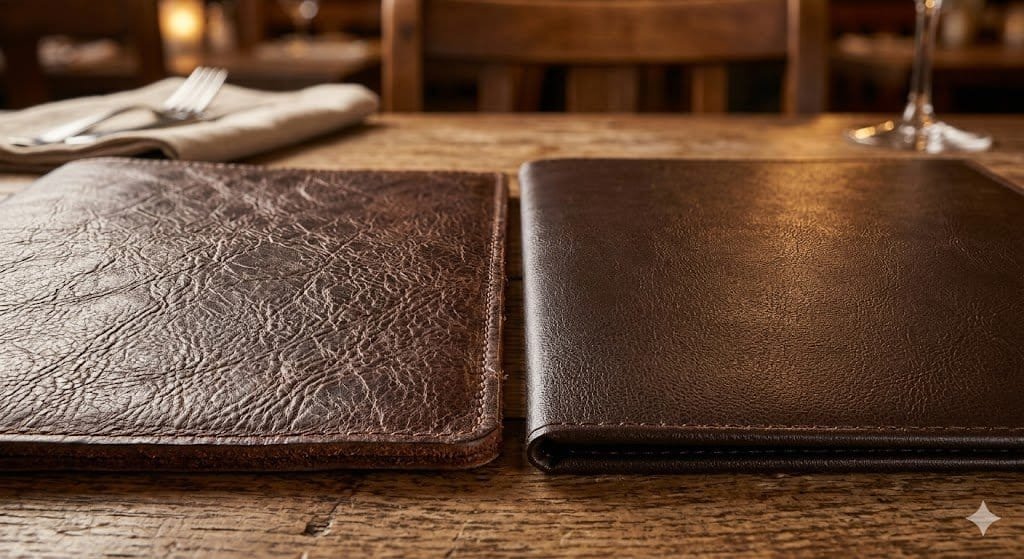
The most honest answer to this question is: it depends on three things — the material, the service environment, and how the covers are handled and stored between services.
A genuine leather menu cover in a fine dining restaurant with 30 covers per night, handled carefully and stored flat, can last eight to ten years. The same genuine leather cover in a high-volume pub that turns 200 covers a night and stacks menus on a damp bar surface might last eighteen months.
This guide gives you realistic lifespan estimates by material and venue type, the factors that accelerate deterioration, and how to extend the life of your covers once they are in service.
Lifespan by Material
Genuine leather: 5–10 years
Full-grain and top-grain leather are the most durable materials available for menu covers. The fibres in genuine leather are dense and interlocked, which gives the material flexibility without the delamination risk that affects synthetic alternatives.
Genuine leather ages rather than deteriorates. Over several years of use, it develops a patina — a slight darkening and softening of the surface that most buyers and guests find more attractive than the original finish. A well-maintained genuine leather cover after five years of service typically looks better than a PU cover after two.
The logo impression on genuine leather — whether blind-embossed or foil-stamped — holds its definition for the full life of the cover. There is nothing to peel, fade or rub off on a well-executed blind emboss in genuine leather.
Realistic lifespan by venue:
| Venue type | Expected lifespan |
|---|---|
| Fine dining (under 50 covers per night) | 7–10 years |
| Mid-range restaurant (50–150 covers per night) | 4–7 years |
| High-volume casual dining (150+ covers per night) | 2–4 years |
| Hotel restaurant (moderate use) | 5–8 years |
| Bar and counter service | 2–3 years |
High-grade PU leather: 2–4 years
High-grade polyurethane leather — sometimes labelled premium PU or bonded leather — performs well for the first two to three years of service. The surface is resistant to spills, easy to wipe clean, and holds its colour consistently.
The characteristic failure mode of PU leather is edge and corner delamination: the polyurethane coating begins to separate from the backing material, typically starting at the corners and spine where the cover is bent most frequently. Once delamination begins, it progresses quickly and cannot be repaired.
High-grade PU covers from reputable manufacturers resist this longer than budget alternatives. The difference between a $9 PU cover and a $14 PU cover is almost entirely in how long the edge bonding holds.
Realistic lifespan by venue:
| Venue type | Expected lifespan |
|---|---|
| Fine dining (low handling) | 3–4 years |
| Mid-range restaurant | 2–3 years |
| High-volume casual dining | 1–2 years |
| Bar and counter service | 12–18 months |
Standard PU leather: 1–2 years
Budget PU leather covers — the type commonly found on wholesale platforms at under $6 per piece — have a significantly shorter service life. The polyurethane coating is thinner, the bonding is weaker, and the backing material is lower grade.
In a high-volume environment, these covers can show visible wear within three to four months: corners softening, surface scuffing, logo foil lifting. In a lower-volume venue with careful handling, they may reach eighteen months before replacement is necessary.
For most hospitality operations, standard PU leather is a false economy: the lower unit price is offset by higher replacement frequency, and the deteriorating appearance in the months before replacement affects the guest experience.
Vegan microfibre leather: 3–5 years
Microfibre vegan leather sits between genuine leather and high-grade PU in both price and durability. It does not delaminate in the way PU does — the microfibre structure is more like genuine leather — but it does not develop the same patina or achieve the same tactile quality.
For venues with a vegan or sustainability brand positioning that rules out genuine leather, high-grade microfibre is the practical alternative. Lifespan is closer to genuine leather than to PU, particularly in moderate-use environments.
Factors That Reduce Cover Lifespan
Understanding what damages menu covers helps you get more life from your current stock and make better purchasing decisions for the next order.
Moisture and damp storage
This is the single most common cause of premature deterioration across all material types. Covers stored while damp — stacked after a spill has not fully dried, or kept in a humid back-of-house environment — develop mould, staining and material breakdown significantly faster than covers stored dry.
Genuine leather stored damp is particularly vulnerable: moisture penetrates the fibres and, once mould establishes, cannot be fully removed. PU leather stored damp traps moisture between the coating and the backing, accelerating delamination.
Simple fix: never stack covers until they are fully dry. A designated dry storage area — not next to a dishwasher or ice machine — extends cover life significantly.
Corner and spine stress
The corners and spine of a menu cover absorb the most mechanical stress: the cover is opened, closed, picked up and set down dozens of times per service. Corners are particularly vulnerable to cracking on PU covers and scuffing on genuine leather.
Covers handled roughly — dropped onto tables, stacked carelessly, bent back past 180 degrees — show corner wear much faster than covers handled with normal care.
Chemical cleaning agents
Cleaning menu covers with general-purpose kitchen cleaning sprays — bleach-based, acid-based or solvent-based — damages both genuine leather and PU surfaces. Bleach bleaches the colour. Solvents attack the polyurethane coating on PU covers. Acid-based cleaners dry out and crack genuine leather.
The correct cleaning method for both materials is a damp cloth with warm water for routine wipe-downs, and a pH-neutral leather cleaner for deeper cleaning. For genuine leather, a light application of leather conditioner two to three times per year prevents drying and cracking.
Heat exposure
Menu covers stored near heat sources — kitchen pass-through areas, under heat lamps, near radiators — dry out faster. Genuine leather becomes brittle when the natural oils in the material evaporate. PU covers can warp or bubble under sustained heat.
Sunlight
UV exposure fades both genuine leather and PU leather covers. For outdoor or terrace dining, this is a significant factor. Covers used exclusively outdoors should be budgeted for replacement more frequently regardless of material quality.
Signs That Covers Need Replacing
Knowing when to replace covers before they become a guest experience problem:
- Corners showing white or cracked edges — delamination has begun on PU covers, or the leather finish has worn through on genuine leather
- Logo foil lifting or rubbing off — the embossing is no longer presenting the brand cleanly
- Persistent odour — mould or mildew that does not clear with cleaning
- Staining that cannot be removed — particularly oil and wine stains that have penetrated the surface
- Covers that no longer close flat — warping from moisture or heat
- Colour fading or uneven patina — covers that no longer match each other across the dining room
A dining room where half the covers are in good condition and half are visibly worn is worse, in terms of guest impression, than a dining room where all covers are uniformly older but consistent. When replacement stock falls below your buffer quantity, it is time to reorder rather than wait.
Extending Cover Life: A Simple Maintenance Routine
For genuine leather covers: – Wipe down after each service with a barely damp cloth – Allow to dry fully before stacking – Apply leather conditioner every three to four months – Store flat or upright — never folded under weight – Keep away from heat sources and direct sunlight
For PU leather covers: – Wipe down after each service with a damp cloth and mild soap if needed – Dry fully before stacking — moisture between covers accelerates delamination – Do not use solvent or bleach-based cleaners – Inspect corners monthly — early-stage delamination can sometimes be pressed back with a leather adhesive before it progresses
For a more detailed cleaning and care guide, see our leather menu cover maintenance guide.
Choosing the Right Material for Your Replacement Cycle
If your venue replaces covers on a fixed schedule — say, every two years regardless of condition — high-grade PU leather is the more economical choice. You are buying to a cycle, not to a lifespan.
If your venue replaces covers when they wear out — which most independent restaurants do — genuine leather almost always produces a lower total cost of ownership over five or more years, as well as a better appearance throughout its life. See our leather vs PU comparison for a full cost analysis.
For high-volume or outdoor venues where any material will wear faster than the economics of genuine leather justify, high-grade PU with a planned 18 to 24 month replacement cycle is the practical answer.
Ready to Order Replacement Covers?
Browse our leather menu covers to see the full range of materials and colours. Use the quote form to send us your quantity, material preference and logo for a direct price.
If you are reordering to match existing covers, send us a photograph or a piece of your current cover and we will match the leather colour as closely as possible from the same service run.
Not sure how many replacement covers to order? See our menu cover quantity guide.
HoReCa Leather supplies custom leather menu covers from Shiling, Guangzhou. MOQ from 50 pieces, 7-day sampling, DHL delivery to Europe and the Middle East.
Ready to source custom menu covers for your restaurant?
MOQ 50 pieces. Sample in 7–10 days. Quote within 24 hours. Factory-direct from Shiling, Guangzhou.