How to Source Hotel Leather Amenities from China — A Procurement Guide
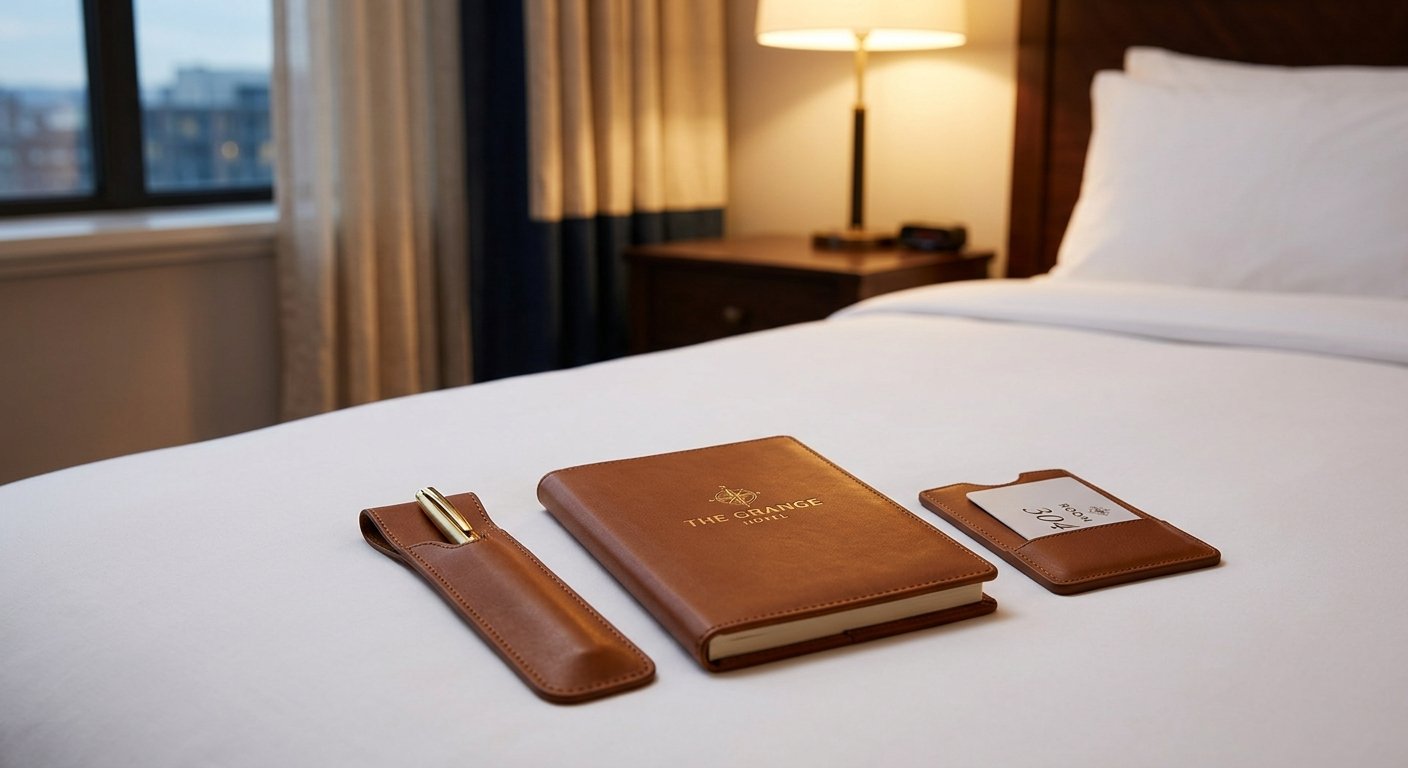
Hotel leather amenities — key card holders, welcome kits, service guide folders, luggage tags — sit at the intersection of brand identity and guest experience. They are the first things a guest touches at check-in and often the last things they pack when they leave. Done well, they communicate quality before a single word is spoken. Done poorly, they undermine the investment made in everything else.
Sourcing these products from China offers significant cost advantages — typically 60–80% lower than equivalent European or North American suppliers. But it introduces complexity around quality control, minimum order quantities, lead times and payment risk that many hotel procurement teams have not navigated before.
This guide covers the full sourcing process: what to buy, how much to order, how to evaluate suppliers, how to manage sampling and QC, and how to structure replenishment so you’re never caught short.
1. The Five Core Hotel Leather Amenity Products
Most hotels source leather amenities in a fragmented way — a key card holder from one supplier, a service guide from another, a welcome kit from a third. This creates colour inconsistency, logo variation and a disjointed guest experience. The right approach is to source all leather pieces from a single supplier who can produce them from the same leather batch.
Here are the five core products and what each contributes to the guest experience:
| Product | Guest touchpoint | Replenishment frequency | Price range |
|---|---|---|---|
| Key card holder Most ordered | Check-in — first physical contact | Every 6–12 months | $2–6/pc |
| Welcome kit (3-piece set) | Room arrival — highest impact | Per occupancy cycle | $15–35/set |
| Service guide folder | In-room — daily reference | Every 1–2 years | $8–20/pc |
| Luggage tag | Loyalty gift / VIP arrival | Based on loyalty programme | $3–8/pc |
| Remote control cover | In-room detail | Every 2–3 years | $4–10/pc |
When all five products are ordered from the same supplier in the same leather colour and with the same logo treatment, the cumulative effect is far greater than the sum of the parts. Guests may not consciously notice each individual piece, but they register the overall quality and consistency. This is what separates a considered hotel experience from a generic one.
2. Quantity Planning: How Much to Order for Your Property
Quantity miscalculation is the most common procurement mistake for hotel leather amenities. Over-ordering ties up capital; under-ordering means you’re back in the market within months with urgent requirements and no time to sample properly.
Key card holders
Order 1.5× your room count as opening stock. For an 80-room hotel, order 120 pieces. The 50% buffer accounts for guests who take the holder (which is good — it is brand exposure after checkout), damage, and the need to replace worn items without immediately triggering a new order. Expect to replenish every 6–12 months depending on occupancy rate.
Welcome kits
Welcome kits are consumed per stay — they are presented to guests and are not typically retrieved and reused. Calculate based on monthly occupancy × months until next reorder. For an 80-room hotel at 70% average occupancy, that is roughly 56 occupied rooms per night × 30 days = 1,680 room-nights per month. If you plan to reorder every 3 months, order 5,040 sets. At MOQ 50 per order, this is well within range.
In practice, most boutique hotels start smaller — using welcome kits for suite guests or VIP arrivals only, then expanding. Starting with 200–300 sets is common for a 60–80 room boutique property.
Service guide folders
Order 1.1× your room count. These are room fixtures, not consumables — one per room plus 10% spare. Expect to replace the full stock every 18–24 months due to wear.
The MOQ reality
Most China factories require 200–500 pieces minimum for hotel leather amenities. Suppliers willing to accept 50 pieces are rare — they are typically sourcing intermediaries based near the factories, not the factories themselves. If you are a smaller property, find a supplier who can do 50-piece minimums rather than forcing yourself to over-order to meet factory MOQs.
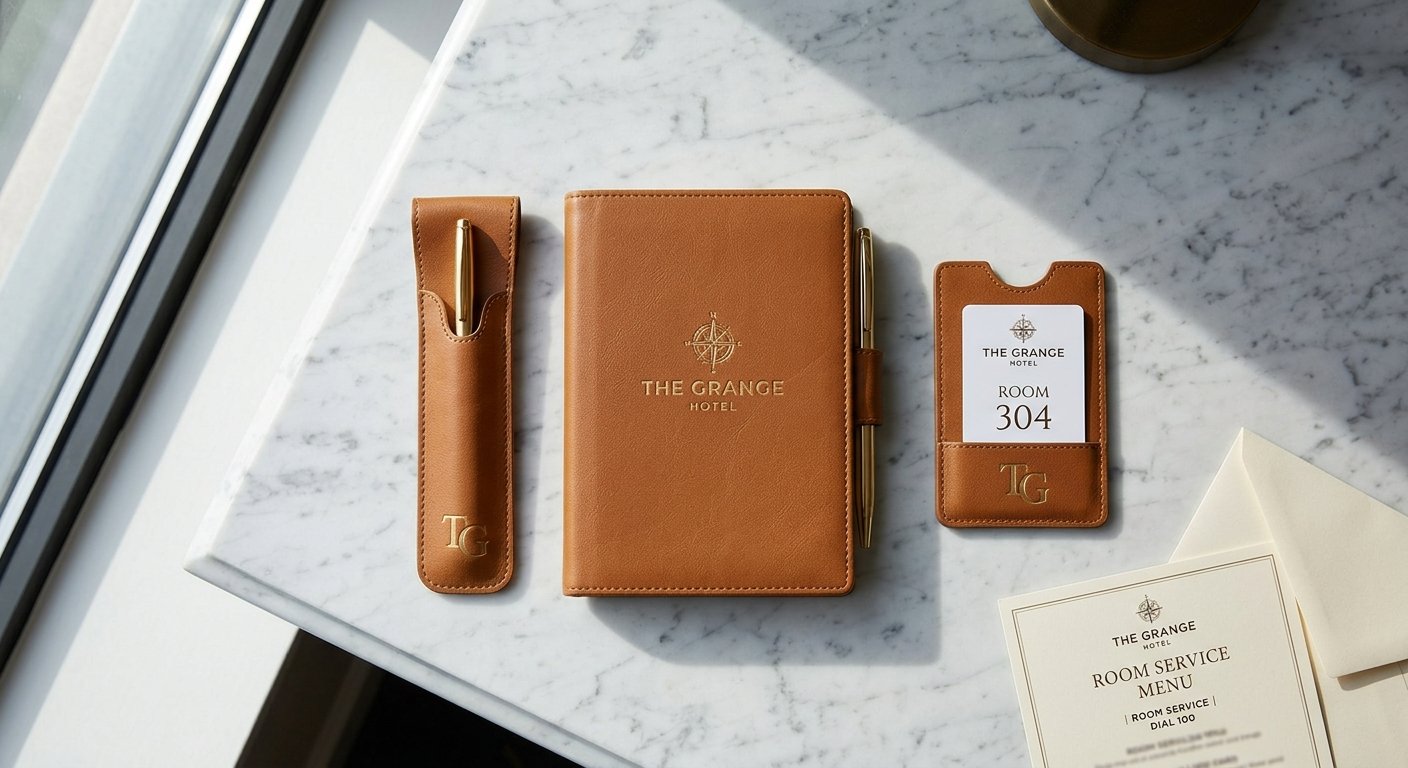
A coordinated three-piece leather welcome kit — key card holder, A6 notebook cover and pen sleeve — in matching tan brown leather with gold foil hotel logo.
3. Evaluating China Suppliers: Five Questions That Matter
There are thousands of leather goods suppliers in China. Most present well online. The difference between a good supplier and a bad experience comes down to five questions — and the answers tell you more than any product catalogue.
1. Where are you based relative to the factories?
This is more important than it sounds. A supplier based in Shanghai or Yiwu is typically a trading company — they manage the factory remotely. A supplier based in or near a manufacturing cluster (Shiling in Guangzhou, Wenzhou, Dongguang) can physically visit the factory and inspect your order. The difference in quality control is significant. Ask for the factory address, not just the supplier address.
2. Can I order a sample before committing to production?
Any legitimate supplier will say yes. The question is the cost and lead time. A reasonable sample fee for hotel leather amenities is $15–40 per piece, with dispatch within 7–10 working days. Be sceptical of suppliers who quote 3–4 week sample lead times — this usually indicates they do not have a direct factory relationship and are placing your sample as a small one-off order through an intermediary.
3. What is your on-site QC process?
There are two types of quality control in China leather sourcing: self-reported (the factory tells you everything is fine) and independent (someone physically visits the factory and inspects the goods). Self-reported QC is essentially no QC. Ask for photos and video of the inspection process, not just finished product photos sent by the factory.
4. What payment methods do you accept?
Wire transfer (T/T) only is a yellow flag for first orders — it provides no buyer protection. Suppliers who also accept PayPal or Wise (TransferWise) are demonstrating confidence in their product, because these platforms offer dispute resolution if goods are significantly not as described. For first orders with a new supplier, using PayPal or Wise significantly reduces your risk.
5. Can you show me previous hotel orders?
Ask for photos of completed hotel leather amenity orders — not stock product photos, but photos of finished goods inspected before shipment. A supplier with genuine hotel experience will have these readily available. If they only have generic product images, they may not have produced hotel-specific leather goods before.
No physical address near manufacturing clusters. Sample lead time over 3 weeks. Wire transfer only with no other payment options. No pre-shipment inspection process. Prices significantly below market rate (a sign of material substitution). Inability to show photos of completed orders for similar products.
4. Material Selection: What Leather Grade for Hotel Use?
Hotel leather amenities are handled frequently and in varying conditions. The material grade needs to balance quality, durability and cost — and the right balance differs by product.
For key card holders
PU leather is the most practical choice. Key card holders are handled multiple times daily, exposed to pockets, bags and occasional spills. PU leather is easy to wipe clean and maintains consistent colour across batches — important when you’re producing hundreds of identical pieces. Full-grain is available for 5-star properties where the extra cost per piece ($1–2 more) is justified by the quality signal at check-in.
For welcome kits
Full-grain cowhide for 4-star and above. The welcome kit is the highest-impact leather piece in the guest experience — the first thing they encounter in the room. The tactile difference between genuine leather and PU is immediately noticeable when picking up the notebook cover or pen sleeve. This is the product where the premium material investment pays off most clearly.
For service guide folders
PU leather is generally sufficient. Service guides are reference items, not gift items — guests use them but don’t take them home. Durability and ease of cleaning are more important than premium feel. Full-grain is available for luxury properties that want total consistency across all leather in the room.
| Product | Recommended material | Reason |
|---|---|---|
| Key card holder | PU leather | High turnover, easy to clean, colour consistency |
| Welcome kit | Full-grain cowhide Premium | Highest guest impact, tactile quality signal |
| Service guide folder | PU leather | Reference item, durability priority |
| Luggage tag | Full-grain cowhide | Taken home, long-term brand exposure |
| Remote cover | PU leather | Handled daily, needs to wipe clean easily |
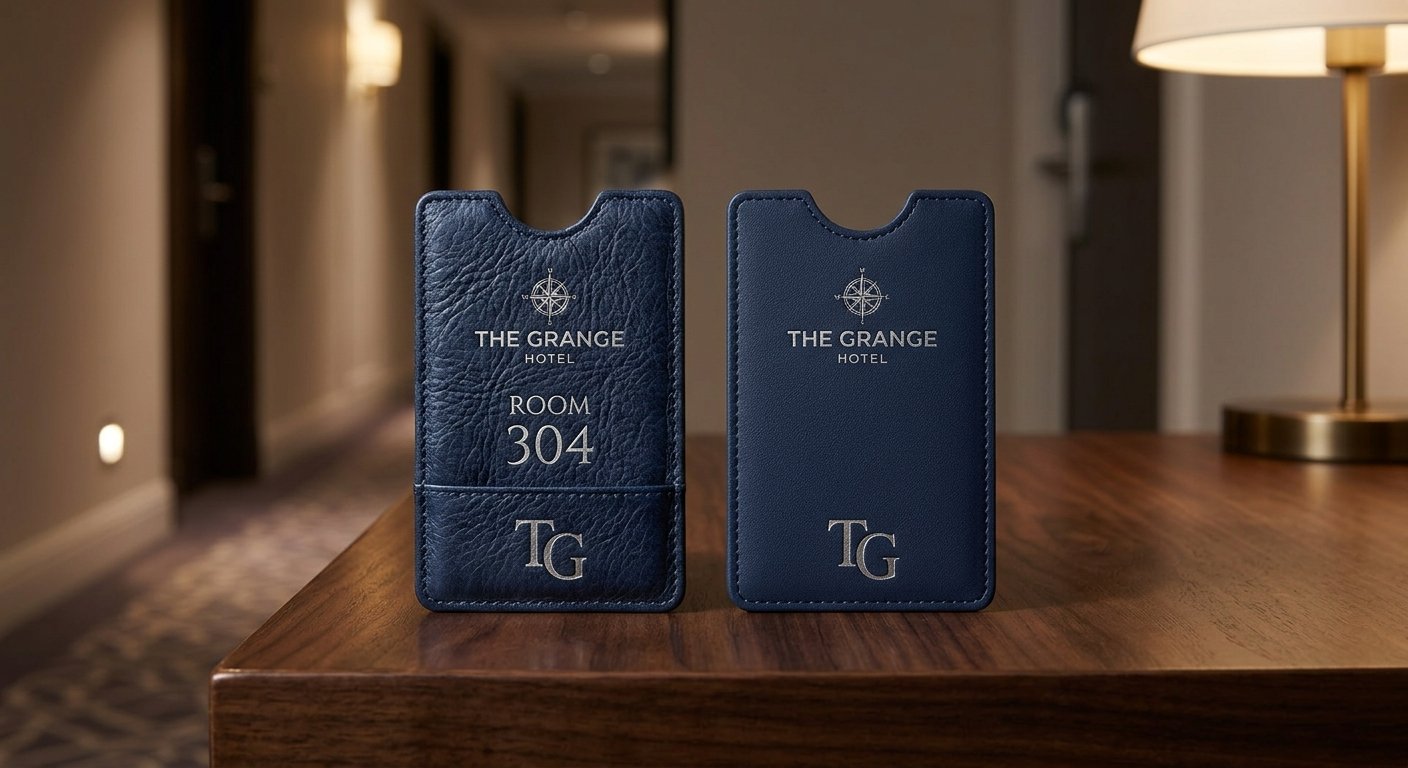
Full-grain leather key card holder (left) and service guide folder (right) in matching navy leather, displayed on a hotel room desk.
5. The Sampling Process: What to Check Before Approving Production
Sampling is not optional for hotel leather amenities. The stakes are higher than for restaurant products because hotels often order in bulk and because the products are associated with the brand identity of a property that cannot easily absorb a quality failure.
When you receive your sample set, check each of the following before approving production:
- Colour consistency across all pieces — lay the key card holder, notebook cover and pen sleeve side by side. They should match. Even slight variation is unacceptable for a coordinated set.
- Logo placement accuracy — measure the logo position against the approved digital proof. Check that the embossing or foil is sharp with clean edges, no blurring.
- Stitching quality — pull gently on corner stitching. It should not shift or separate. Check that stitching colour matches or complements the leather.
- Leather smell — genuine full-grain leather has a characteristic natural smell. A strong chemical smell indicates a lower-grade material than specified.
- Card slot function — insert a standard credit card into the key card holder. It should slide in and out smoothly without forcing.
- Notebook fit — if you have a specific notebook brand, insert it into the notebook cover. Check that it sits flat and that the cover closes properly.
- Hardware quality — if any pieces have metal hardware (snap closures, eyelets, D-rings on luggage tags), check they operate smoothly and show no surface defects.
Send written approval (email is sufficient) once you are satisfied with the sample. Reference the sample number or date. This becomes the production benchmark — if the finished goods deviate significantly from the approved sample, you have documented grounds for remedy. Never approve production verbally.
6. The Full Sourcing Timeline: From Enquiry to Delivery
Total timeline from first enquiry to delivery: approximately 8–9 weeks for a first order. Reorders of approved designs take 3–4 weeks from order placement to delivery.
7. Managing Replenishment: Never Running Out
The biggest operational risk with hotel leather amenities is running out of key card holders mid-season. Because the production and delivery cycle is 3–4 weeks for reorders, you need a system that triggers reorders before stock is critically low.
The reorder trigger rule
Set your reorder trigger at 30% of standard holding stock. For an 80-room hotel holding 120 key card holders, trigger a reorder when stock drops to 36 pieces. This gives you 3–4 weeks of buffer while production and delivery completes.
Keeping specs on file
After your first approved order, a good supplier keeps your specifications permanently on file — leather colour, logo embossing stamp, card slot configuration, exact dimensions. Reorders require a single email with quantity and delivery address. No sampling, no artwork submission, no spec negotiation. This is a key benefit of building a long-term relationship with one supplier rather than re-tendering each order.
Annual supply agreements
For larger properties or groups, consider an annual supply agreement that locks in pricing for 12 months in exchange for a volume commitment. This protects you from raw material price increases and guarantees production priority during peak manufacturing seasons (typically October–December in China, when factories are busy with Christmas orders).
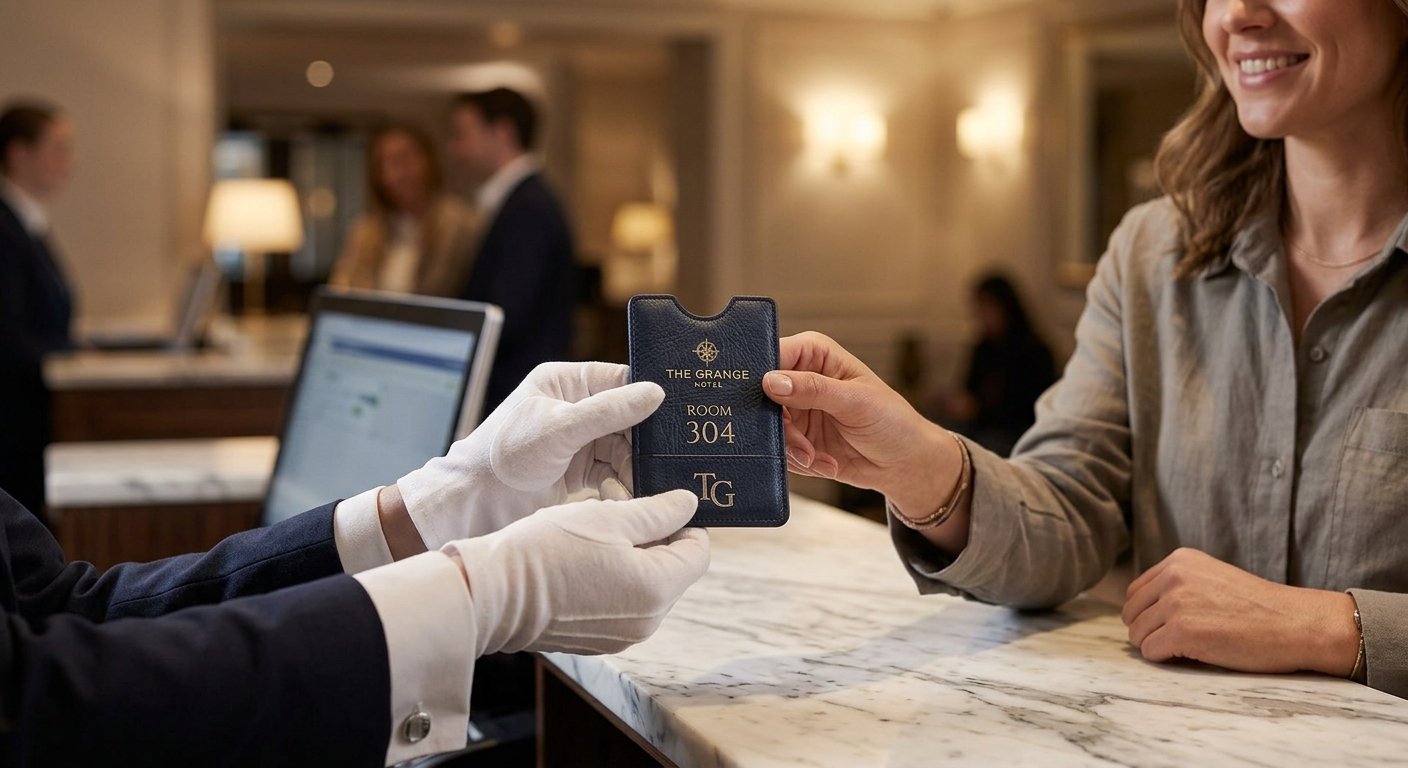
A hotel front desk check-in moment: staff member handing a leather key card holder to a guest. The hotel logo is visible on the holder.
8. Payment Terms and Risk Management for First Orders
Paying a new China supplier involves real risk. The leather goods industry has its share of suppliers who deliver lower quality than sampled, or who delay production without communication. Here is how to structure your first order to minimise exposure.
Payment structure
- Sample orders: 100% upfront. Sample fees are small ($50–200 total for a hotel amenity set) and the risk is low. If samples are not delivered, the loss is limited.
- Production orders: 50% deposit to start production, 50% balance on approval of the pre-shipment inspection report — before the goods are dispatched. Never pay 100% upfront for production.
Payment method choice
- PayPal or Wise (first order): both offer dispute resolution if goods are significantly not as described. The fee is worth the protection for first orders. Suppliers who refuse PayPal entirely for production orders are worth being cautious about.
- Bank wire (T/T) for established relationships: once you have one successful order with a supplier, wire transfer for subsequent orders is standard and fine. The supplier has already demonstrated they deliver.
Pre-shipment inspection as payment leverage
Structuring the balance payment after pre-shipment inspection approval is one of the most effective risk management tools available. The supplier needs the balance payment to release the goods for shipping — this gives you genuine leverage to require quality corrections before anything leaves China. Always require a photo and video inspection report before releasing the balance.
9. The Middle East Hotel Market: Specific Considerations
The UAE, Saudi Arabia and Qatar represent a major and underserved market for premium hotel leather amenities. The concentration of luxury hotels in Dubai, Abu Dhabi, Riyadh and Doha, combined with strong procurement budgets and genuine preference for premium branded amenities, makes this one of the most valuable markets for China-sourced hotel leather.
Shipping
DHL Express from Guangzhou to UAE typically arrives in 5–6 working days. Saudi Arabia and Qatar are 6–7 days. Import duties on leather goods in the GCC are generally 5% — confirm with your customs broker for the specific HS codes of your products.
Colour preferences
Middle East luxury hotel properties tend to favour richer, darker leather tones — dark brown, navy and black are most commonly specified. Gold foil logo stamping is strongly preferred over silver or deboss for premium properties. Some properties request Arabic text alongside the English hotel name for local guest markets.
Volume and timing
The Middle East hotel market has two major opening seasons — pre-Ramadan (February/March) and pre-summer (May/June). Procurement orders for new property openings typically need to be placed 10–12 weeks before the target opening date to allow for sampling, production and delivery with a comfortable buffer.
10. Pre-Order Checklist for Hotel Procurement Teams
- Identified all products needed and quantities per product
- Calculated opening stock and replenishment schedule
- Selected leather colour for the full coordinated set
- Prepared hotel logo in vector format (AI, EPS or PDF)
- Decided on logo technique (gold foil / silver foil / blind deboss)
- Specified packaging requirements (poly bag / branded gift box)
- Confirmed delivery address and required-by date
- Ordered samples — all products in the set simultaneously
- Approved samples in writing before production deposit
- Confirmed pre-shipment inspection process with supplier
Ready to source your
hotel leather amenities?
MOQ 50 pieces per product. Sample set in 7–10 days. Quote within 24 hours. Factory-direct from Shiling, Guangzhou.